Simple activities. Colorful little moments.

Free Printable Counting Cards 1–10: 5 Playful Activities
Download free printable counting cards 1–10 and a ten-frame mat. Try five simple number games with easy ways to adjust the challenge for your child.

These free printable counting cards pair the numerals 1 to 10 with matching groups of dots. Use them for short games at the kitchen table, a preschool math station or a quiet activity with an adult. The two-page PDF also includes a ten-frame mat for drawing quantities.
Start with two or three cards rather than the full set. A child who can say a long number sequence may still need practice touching one object for each number word. The aim is to explore quantities together, not to finish every card in one sitting.
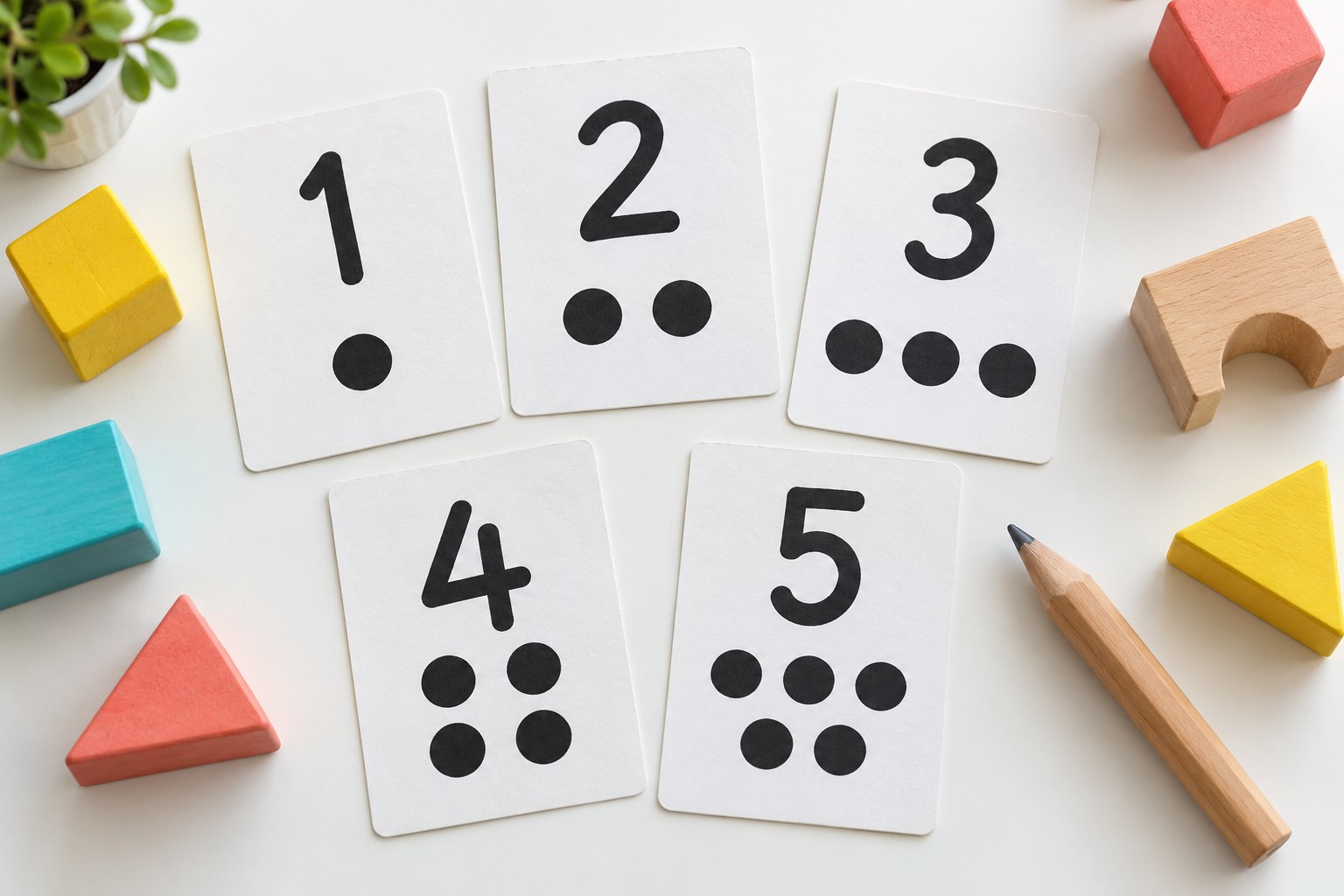
Download the counting cards and ten-frame mat (PDF, 2 pages)
What is included in the printable?
- Page 1: ten cut-apart cards, each with a numeral and the matching number of dots
- Page 2: a blank ten-frame with spaces for a number, one more and one less
- Black-and-white artwork that works with ordinary printer paper
The PDF uses US Letter pages. Select ‘Fit’ when printing on A4 or if your printer clips the edges. Have an adult cut the cards along the borders. You can leave the sheet whole and point to a card if cutting is inconvenient.
1. Touch and count the dots
Put the 1, 2 and 3 cards face up. Choose one and slowly touch each dot while saying one number word. After the last dot, repeat the total: ‘One, two, three. There are three dots.’ Invite the child to choose a card and try, or count together if they prefer.
If a child skips a dot or counts it twice, model a slower pass without turning the game into a test. NAEYC’s guide to dot-card and finger games explains how these games connect counting, quantities and written number symbols.
2. Build a matching group
Place a card beside a small group of large blocks. Ask, ‘Can we make a group that matches this card?’ Move one block at a time into a line. Count the completed group together, then move the same blocks into a circle and check whether the total has changed.
Use large, age-appropriate objects instead of coins, beads or other small pieces. Drawing circles is another option. Keep the task to a few objects while the child is learning how to count each one once.
3. Put three cards in order
Shuffle three consecutive cards, such as 2, 3 and 4. Let the child arrange them from the smallest group to the largest. Count the dots to check. When this becomes familiar, add a fourth card or leave a gap and ask which number could go in the empty space.
4. Fill the ten-frame
Choose a card and draw that many circles in the blank frame, starting at the left of the top row. Use one circle in each square. For 7, fill the first row of five and then two squares underneath. Talk about what you see: ‘Five here and two more there.’
The ‘one more’ and ‘one less’ spaces are optional. Use them only when your child is comfortable with the main task. If you choose 10, one more is 11 and will not fit inside this ten-frame; write 11 in the answer space or use a smaller card for the drawing game.
5. Play find my number
Set out three cards. Clap slowly twice and ask the child to find the matching quantity. Swap roles so the child claps while you choose. Other clues could be two raised fingers or three large blocks. Keep the cards visible and give plenty of time to compare them.
Keep number play short and flexible
Five interested minutes are more useful than completing a sheet after everyone is tired. Stop or switch games when the child loses interest. These cards are an activity resource, not an assessment or a promise about when children should reach a milestone.
For a movement break, try our indoor scavenger hunt printable. For a group game with less emphasis on numbers, use the animal charades cards.
Common questions
Do I need to laminate the cards?
No. Ordinary paper works for a first try. Print on cardstock if you already have it and want sturdier cards. Store the set in an envelope between games.
Can I print a set for my classroom?
Yes. This original Creative Play Hub PDF is free for personal and classroom use. When sharing online, link to this article so other families and teachers can find the instructions and download.