Simple activities. Colorful little moments.

Free Printable Dots and Boxes Game: Two Small Grids
Download a free printable dots and boxes game with two small grids. Learn turns, extra moves, scoring and a cooperative version with a clear example.

This printable dots and boxes game is a two-player pencil game with a small board and a clear goal: complete more squares than your partner. Each turn adds one line between neighboring dots. Completing a square earns a point and another turn.
The one-page download has two separate 4-by-4 dot grids. Each grid contains nine possible boxes, so it is a manageable starting size. Use one grid per game, with two different pencil colors or a different initial for each player.
Download the two-grid game sheet
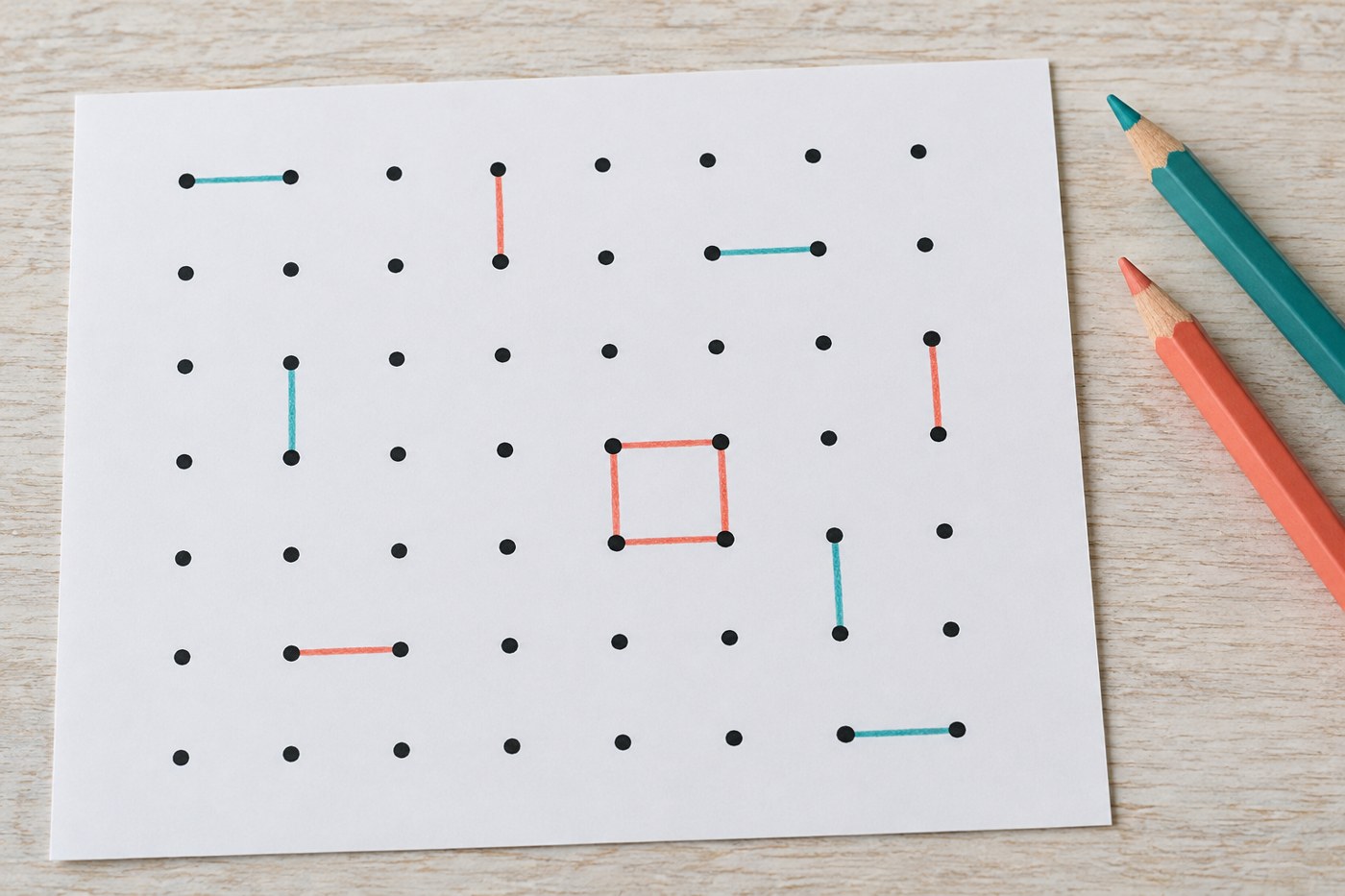
The PDF includes two blank boards, a short rules reminder and score spaces. It is black and white on US Letter paper; use Fit to page for A4. No signup is required. The generated illustration is an example scene; the actual sheet preview and download show the smaller grids you receive.
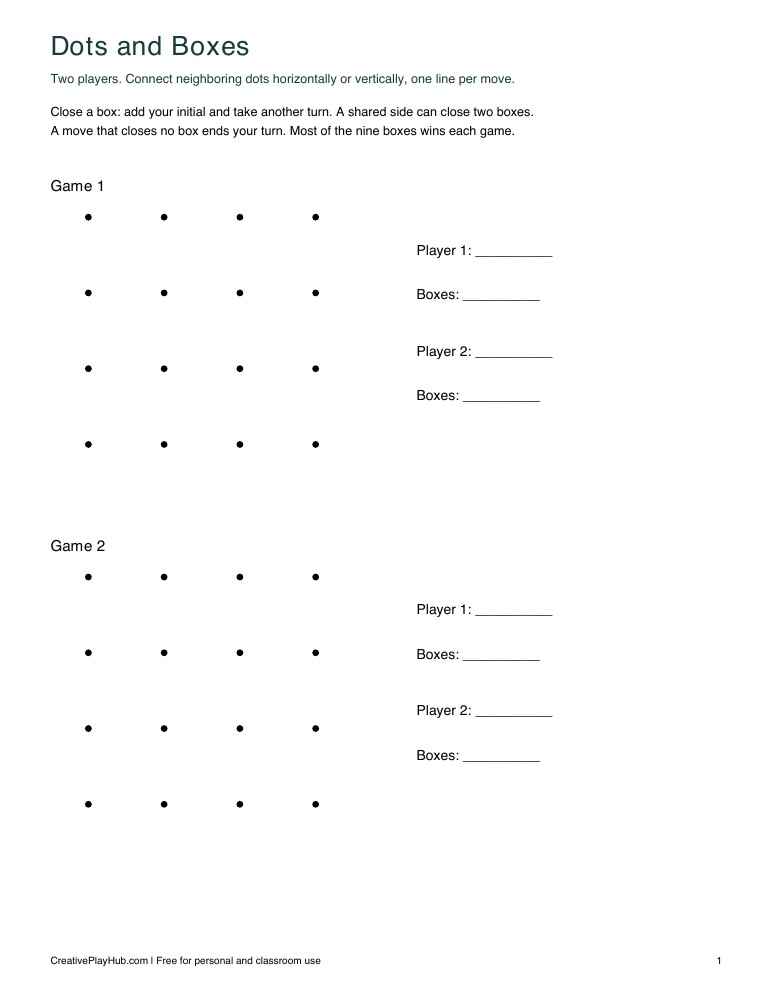
Print one page for two games. If printing is unavailable, view the rules on a screen and draw four rows of four evenly spaced dots on spare paper. Leave enough space between dots for a small initial inside each completed square.
Set up before the first move
Choose who starts and assign each player a color or initial. Agree that lines must be horizontal or vertical between immediately adjacent dots. Diagonals, skipped dots and drawing over an existing line are not allowed.
Count the dots together: four across and four down. The spaces between them make three rows of three boxes. This distinction avoids expecting sixteen boxes simply because there are sixteen dots.
Take turns drawing one line
The first player connects two neighboring dots. The second player adds a different line. Continue alternating while neither line completes a box. Players may draw anywhere on the chosen grid, not only next to the previous move.
When your line closes the fourth side of a box, write your initial inside it. You must then take another turn. Keep going for as long as each new line completes at least one box; your turn ends when you draw a line that completes none.
A worked example of an extra turn
Imagine one small square already has a top, left and bottom line. Mia draws its missing right side, writes M inside, and scores one box. Mia now draws again. If her next line does not close a box, Leo takes the following turn.
One line can finish two boxes at once when it is the shared missing side of neighboring squares. Claim both boxes and take one further turn. It does not give two stored turns to use later.
Finish and check the score
The game ends when all nine boxes are claimed. Count initials rather than lines: a player who drew many sides may still have fewer boxes. The two scores must add up to nine. With two players on this board, a correctly completed game cannot tie.
If a box was missed, look at the move that closed it and agree who completed it before continuing. A quick pencil mark inside each box as soon as it is claimed prevents most scoring confusion.
Make the first game easier
For an introductory game, play cooperatively and try to close all the boxes together. Say aloud when a square has three sides and point out the available closing move. Once the rule is familiar, start a separate competitive game.
For players ready to plan ahead, ask what a proposed line would leave for the other person. Do not promise a winning strategy: this guide teaches the rules. Switch the starting player for the second grid so both get a first move.
Keep a small game folder
The sheet is free for personal and classroom use. Share this article link when passing it to another family rather than redistributing or selling the file. A clipboard and two pencils make it easy to use away from a table.
For a less strategic activity, try draw and guess. For a group that prefers matching pictures, use our four-board picture bingo.