Simple activities. Colorful little moments.

Indoor Color Scavenger Hunt: A Simple Find-and-Sort Game
Set up an indoor color scavenger hunt with four paper color stations. Includes no-print instructions, a pointing version and ideas for mixed-color objects.

An indoor color scavenger hunt gives children a clear mission: find something that matches a color, then decide where it belongs. You can begin with just two colors and objects already in the room. This version needs no printable checklist and works either as a collecting game or a seated pointing game. Set aside about fifteen minutes, including setup.
At a glance: allow about 5 minutes to prepare and 10 minutes to play. Start with one child or a small group, two to four colors, and one room. An adult chooses the objects and supervises. No printer or purchased game is needed.
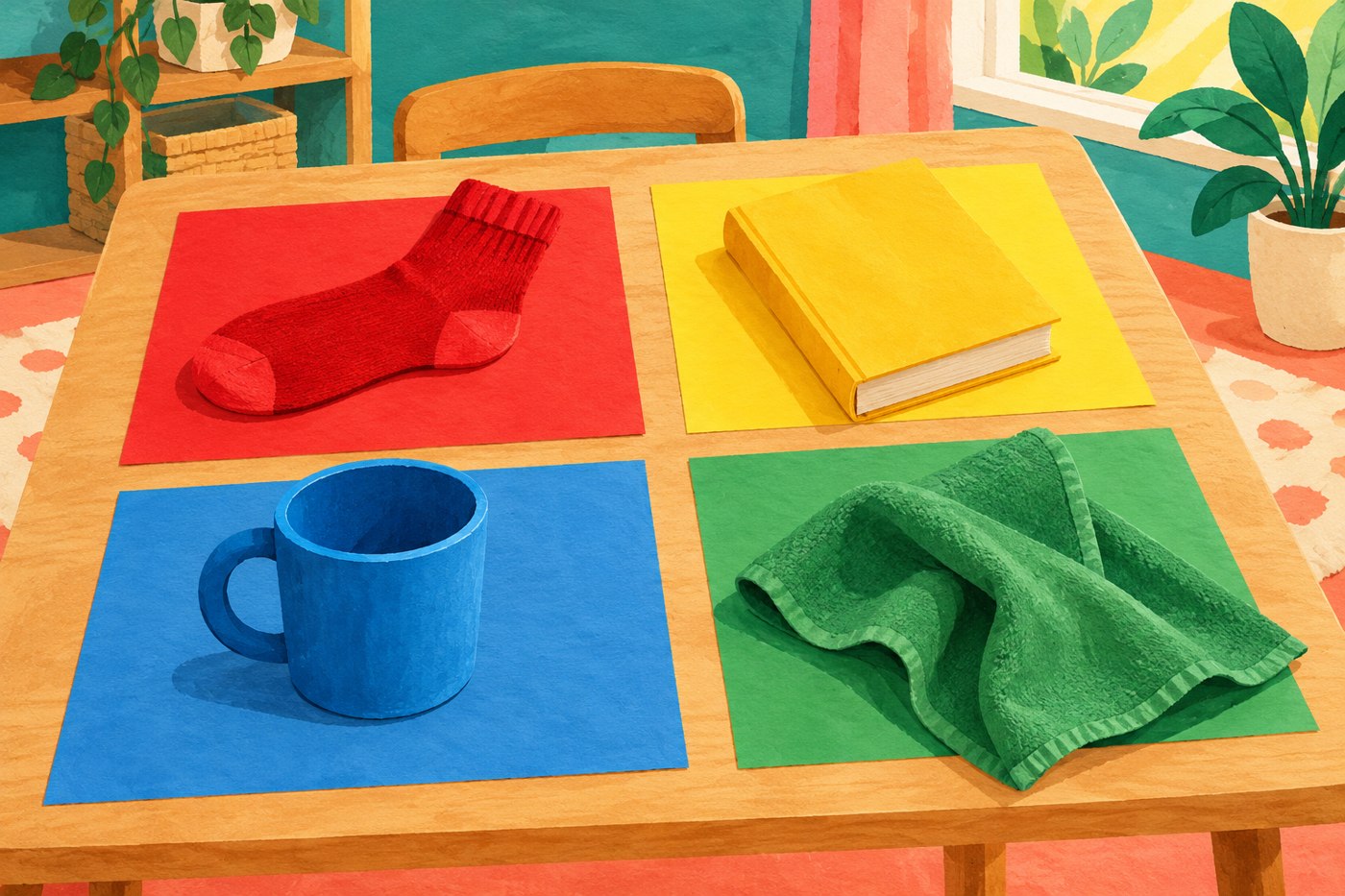
What you need for an indoor color scavenger hunt
Gather two to four sheets of colored paper, or white paper with large crayon swatches. Choose large, easy-to-handle objects already in your room: a red sock, a blue plastic cup, a yellow book or a green washcloth. A tray is optional; children can carry one object at a time instead. Color words can be added to the paper, but reading is not required.
Quick start: your first four finds
Put the color sheets together where everyone can reach them. Say, “Can you find something red?” Show the red swatch as you speak. After the first object returns, compare it with the swatch and leave it at that station. Repeat for yellow, blue and green. Stop after four finds if interest fades, or begin another round with different objects. There is no timer, winner or penalty for asking for help.
1. Choose a small, safe search area
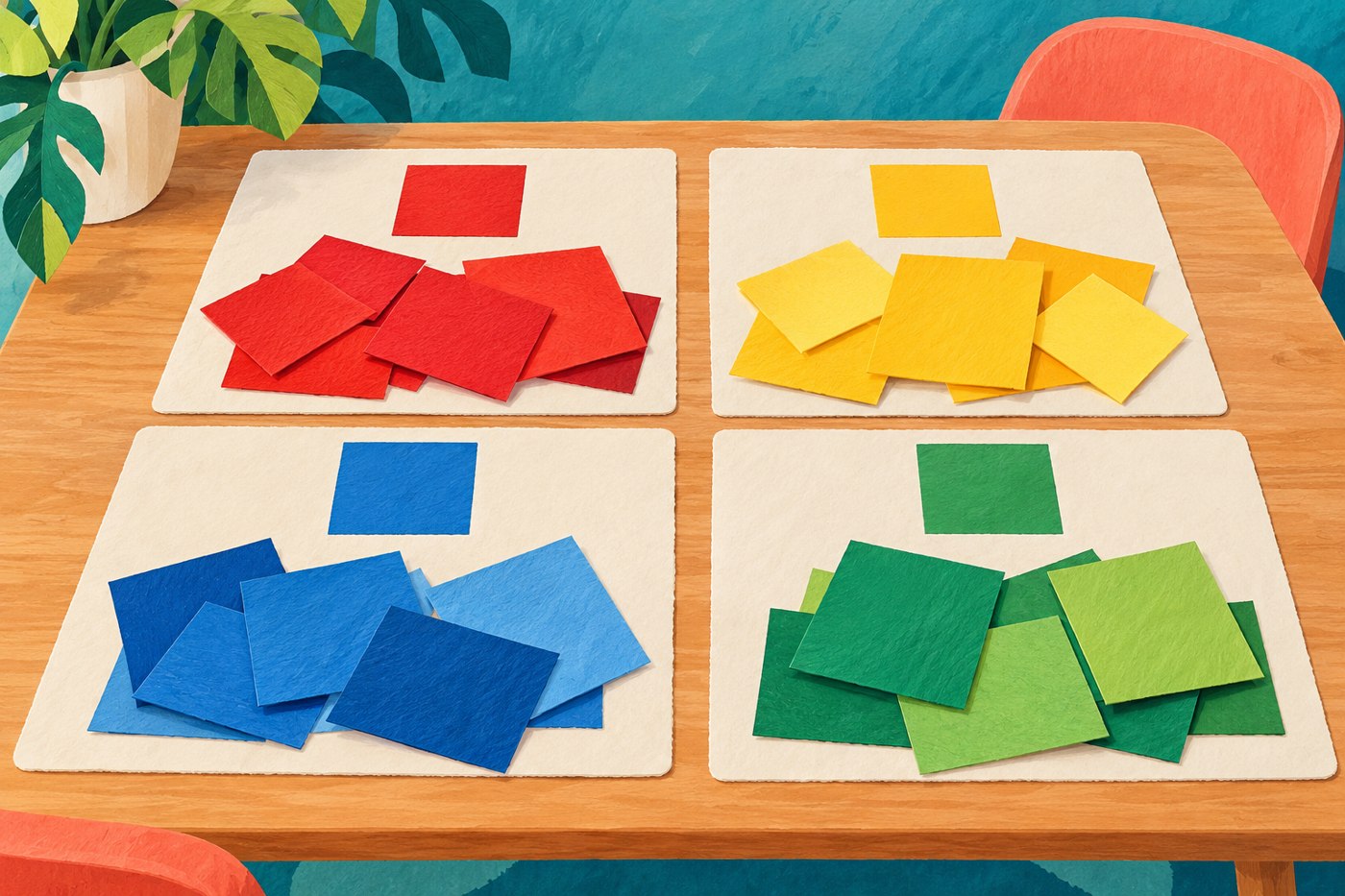
Pick one room and choose four colors that appear in things children can reach: red, yellow, blue and green are a useful starting set. Place a sheet of colored paper for each color on a table or the floor. If you have only white paper, draw a large swatch on each sheet with a crayon.
Before play, identify which objects can be moved. Books, socks, cloths and large plastic cups are possibilities. Leave glass, electrical items, medicines, plants and small loose parts out of the game. Agree that nobody climbs, opens cupboards or moves another person’s belongings. An adult can place a few suitable objects in view first.
2. Find one match at a time
Invite the child to choose one color station. Ask them to find a matching object, bring it back and place it beside the paper. Then choose another color. Start with one object per station rather than asking for a large collection immediately.
Name the relationship as you play: “This sock is red, like the red paper.” If an object goes to an unexpected station, ask what color the child noticed. A patterned sock may have several valid matches. The conversation is more useful than silently correcting their choice.
3. Handle stripes, shades and missing colors
For a multicolored object, let the finder choose one visible color and explain or point to it. Alternatively, make a separate space for objects that match more than one station. Do not count the same object twice when comparing the number of objects in each group.
If you cannot find anything green, acknowledge the empty station and choose a different color. If light blue and dark blue cause confusion, put the objects side by side and discuss how they are alike and different. Keep the first round focused on broad color groups rather than exact shades.
4. Use pointing instead of collecting
For a seated version, show one color sheet and ask players to point to a matching object in the room. The adult names or describes what was found. This works when moving objects would be inconvenient or when players have different mobility needs.
With two or more children, take turns choosing the next color. Keep the game cooperative: everyone helps fill the stations, and nobody loses for needing a clue. A clue can narrow the search to one area, such as the bookshelf, without naming the object.
5. Finish with a quick sort and reset
Look at the completed stations together. Ask which has more objects, which has fewer, or whether two groups have the same amount. Count only if that adds to the game. Then return each object to its place; the reset can become a second hunt for where things belong.
For a table activity using printed cards, try our free color matching game. If you would rather search by object than color, use the indoor scavenger hunt printable.
Three ways to change the game
Make it simpler: set out only two colors and two obvious matching objects nearby. Demonstrate one match, then offer the second object. A child can match by looking without being asked to say the color name.
Add a clue: once ordinary matching is easy, ask for something blue and soft, or something red you can wear. Choose clues that have a real answer in your search area. If the clue is too narrow, remove one condition and keep playing.
Try a paper-only hunt: place large colored paper pieces around the room in clear view. Find them and return them to matching sheets. Use broad pieces rather than tiny scraps, and keep all materials away from children who mouth paper. This version keeps household belongings in place.
Common questions
Is this suitable for toddlers? Adapt the task to the child rather than relying on an age label. Use two colors, large safe objects and close adult supervision. Pointing together may be more manageable than carrying. Stop if the child starts mouthing materials or loses interest.
What if my child does not know the color names? Hold up the swatch and invite them to find something that looks similar. Matching and saying a color name are different tasks. Model the word naturally without turning each find into a test.
What if colors are difficult to distinguish? Let the player choose colors they can tell apart, compare objects directly against the paper and avoid speed challenges. If that is still frustrating, switch to a texture or shape hunt. This activity is not a vision assessment.
Can we play without colored paper? Yes. Use a large crayon swatch on white paper or choose one safe object as the color reference. A red sock can be the starting clue for finding another red thing. Keep the reference visible throughout the round.
Does this activity include a printable? This version is deliberately no-print. For a ready-made object checklist instead, visit our free indoor scavenger hunt printable. It uses a different search rule, so choose whichever suits your group.
Finish while the game is still enjoyable. Four thoughtful finds and a shared cleanup can be a complete activity; you can choose different colors another day.