Simple activities. Colorful little moments.

Kindness Card Activities for Kids: 7 Ways to Turn Words into Actions

Kindness card activities for kids work best when a message leads to a small, practical action. A card that says “You are helpful” is pleasant to receive; a card that says “Thank you for finding my missing shoe” tells a child exactly what someone appreciated.
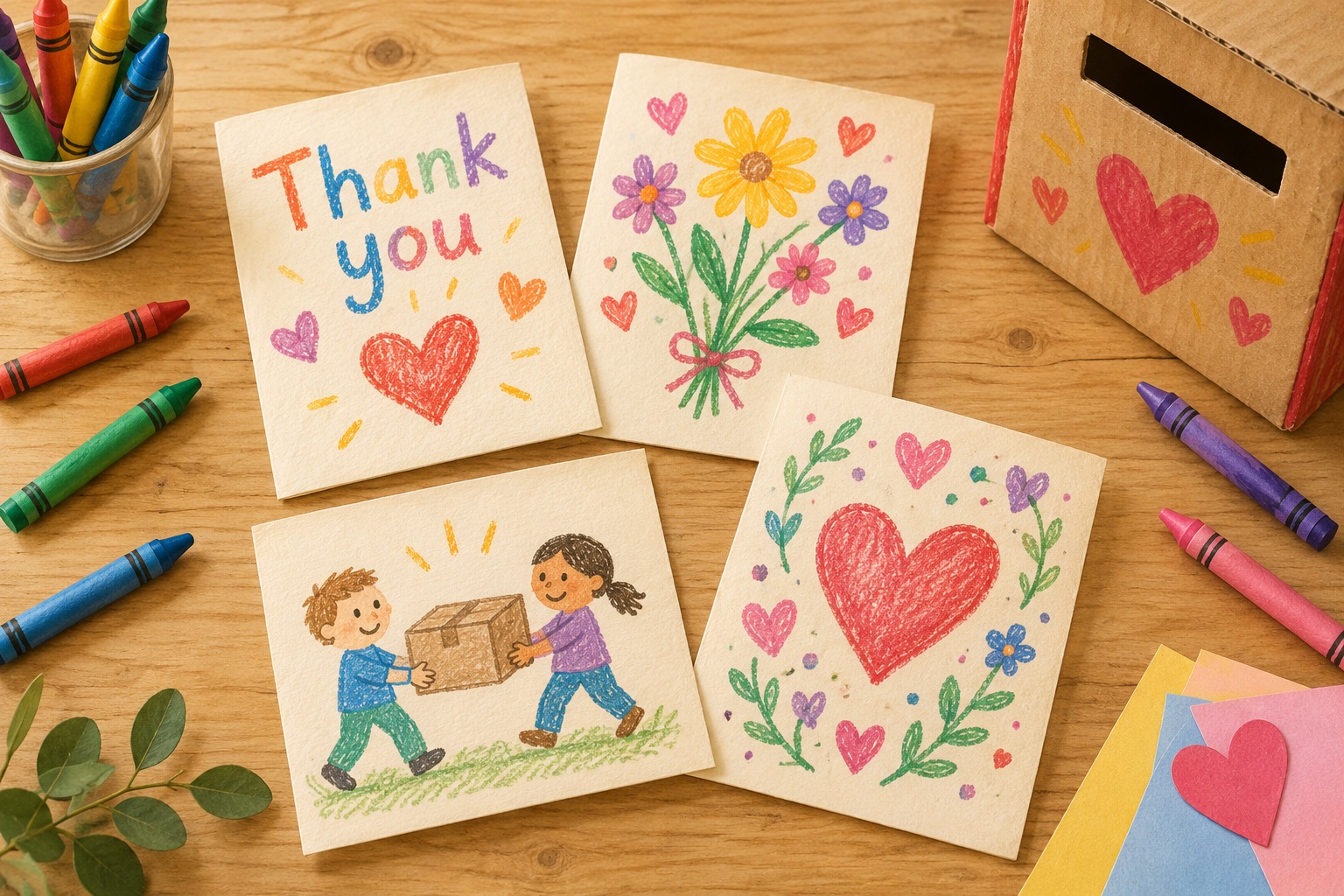
Use these seven ideas at home, with siblings or in a small group. You need paper, a pencil and about ten minutes. Children can draw their messages, dictate to an adult or write independently. For ready-made starting prompts, use our free printable kindness cards.
A simple setup that avoids pressure
Fold one sheet of paper into four sections and cut or tear along the folds. Put the cards beside a few crayons. Explain that a kind message should be true, specific and welcome. Nobody has to read a card aloud, give a hug or tell another child they are friends.
Offer three sentence starters: “Thank you for…”, “I noticed you…” and “Would you like help with…?” Let the child choose a person they know. Keep names and personal messages within the family or group instead of posting them publicly.
1. Notice one helpful action
Ask, “What did someone do today that made a task easier?” Write the answer as a short thank-you. For example: “Thank you for holding the box while I put the blocks away.” Add a drawing of the action and deliver the card privately.
If the child cannot think of anything, model your own example rather than supplying praise for them to copy. Looking for a real moment is the whole activity.
2. Pair a card with an offer of help
Write “Would you like help with your puzzle?” or “Can I carry one of the books?” Then ask the person before helping. A kind offer can receive a “no, thank you”; accepting that answer is part of the game.
Choose a manageable action, such as returning crayons or setting out napkins. Avoid promises the child cannot reasonably keep, like “I will always clean your room.”
3. Make a quiet welcome card
For a visiting cousin or a new member of a familiar group, draw two available activities: blocks and coloring, for example. Add “You can choose.” The card gives the recipient an easy way to join without being put on the spot.
Keep this within an adult-supervised setting. The child can leave the card beside the activity rather than making a speech.
4. Create a family appreciation postbox
Use an empty tissue box as a postbox. Each person may add one specific thank-you during the week. Open the box together, but allow private delivery if someone prefers it. Our pretend post office activity can supply the delivery-game setup.
Do not count cards to decide who is kindest. If using this with a group, an adult should plan distribution so one child is not publicly left without a message.
5. Turn a vague compliment into a detail
Read “You are nice” and ask what happened that made you think so. Rewrite it as “You waited while I finished my turn.” Compare the two messages without calling the first one wrong.
Younger children can point to a drawing while an adult supplies the words. Older children might add how the action helped: “That gave me time to finish.”
6. Make a try-again card
After a minor disagreement has settled, offer a card saying “Next time I can…” The child might draw asking before borrowing a toy. This is a plan for a different action, not a forced apology.
A card does not replace returning an item, repairing damage or respecting another person’s wish for space. If the child is still upset, leave the activity for later.
7. Keep a private kindness reminder
Some children prefer making a reminder for themselves: “Ask before taking,” “Leave space for someone else,” or “Put the shared pieces back.” Place it near the activity where it is useful.
At the end of the day, ask whether the reminder helped. Skip scores, prizes and public comparisons; the aim is to make one helpful action easier to remember.
A ten-minute routine to repeat
Spend two minutes remembering a real moment, five minutes making a card and three minutes deciding how to deliver it. Stop after one card if attention runs out. A small message with a clear purpose is enough.
Common questions
What if my child does not want to write? Offer drawing, dictation or a spoken thank-you. Writing is only one way to take part.
Can siblings exchange cards? Yes, when both want to. Do not require a matching compliment in return.
Should we do this every day? Use it when there is something genuine to say. A weekly invitation can feel easier than a daily requirement.