Simple activities. Colorful little moments.

Masking Tape Maze for Kids: Build a Tabletop Route with 4 Challenges

A masking tape maze for kids turns a flat piece of cardboard into a route to plan, test and change. Unlike a road town, a maze includes a decision: which path reaches the finish, and which one leads to a dead end?
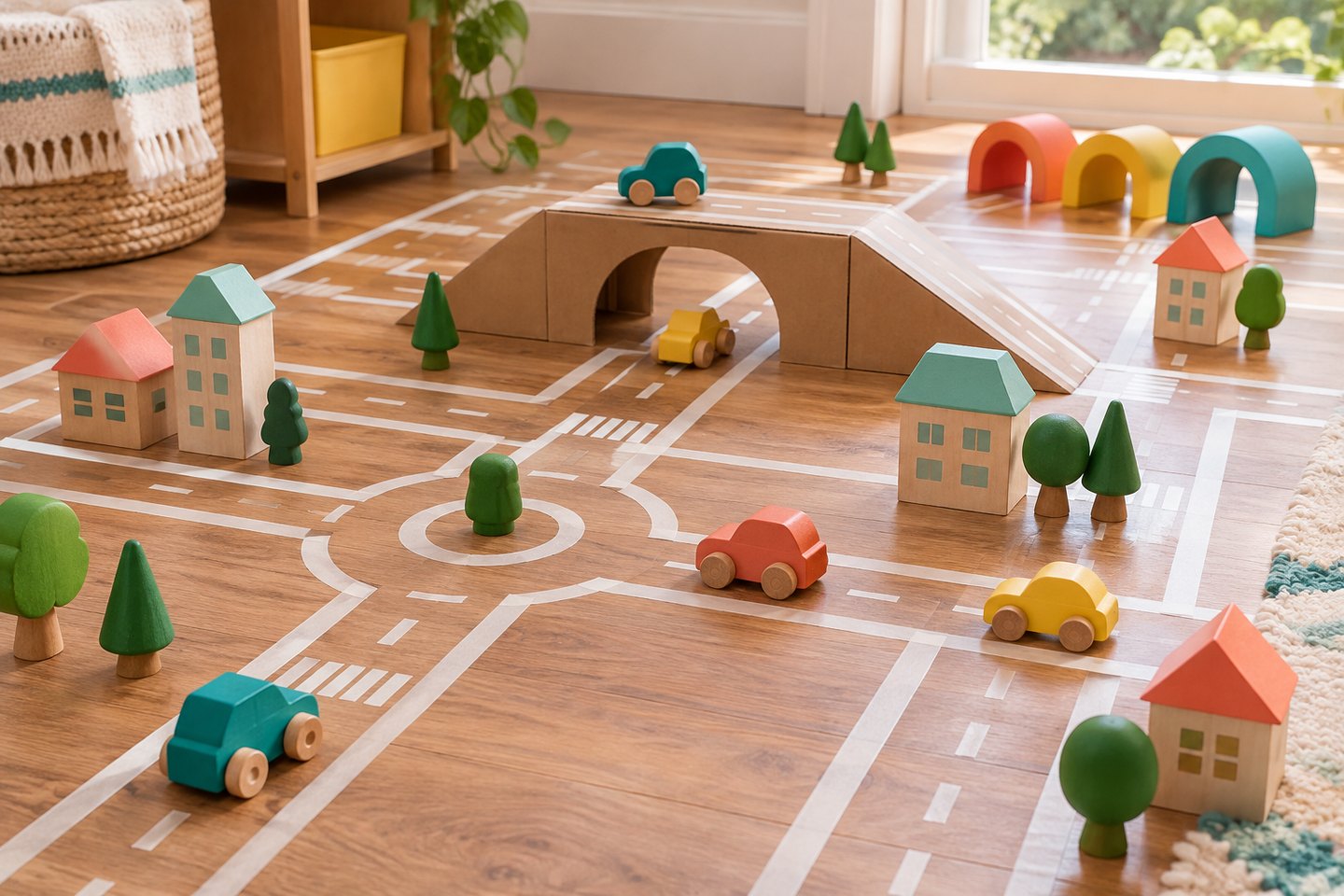
This version stays on a tabletop or a low, stable play surface. Children move a toy car or a large folded-paper character through it; they do not need to walk or balance on tape. Allow about ten minutes to build and another ten to play.
Gather a small set of supplies
You need a large, flat piece of cardboard, masking tape, a chunky toy vehicle or folded-paper character, and a pencil. An adult should remove staples and sharp edges from reused packaging before play.
Use the cardboard as your tape surface rather than applying tape directly to painted furniture or delicate flooring. Tape can damage finishes or leave residue. If you choose another surface, follow its care instructions and test a hidden patch first.
Build the first route before adding dead ends
Mark START near one edge and FINISH near the opposite edge. Move your chosen car across the cardboard to check how much room it needs to turn. Make the pathway noticeably wider than the car.
Lay two strips of tape as the sides of a short corridor. Add one gentle turn and continue to the finish. Leave the center of the corridor uncovered: the car travels between the tape lines.
Test the complete route yourself. Then add one branching corridor that ends before the finish. Close its far end with a tape strip so it is clearly a dead end. A single branch is enough for the first round.
Challenge 1: Plan before driving
Ask the child to trace a possible route with a finger before moving the car. Then drive the route and see whether it reaches the finish. If it reaches a dead end, reverse to the last junction and choose again.
Do not require speed. A child can say “straight, turn, stop” while moving, or simply point. If the maze is confusing, cover the extra branch with a sheet of paper and try the main route first.
Challenge 2: Make one delivery
Draw a small house beside the middle of the successful route. The car must visit the house before going to the finish. A large paper square can stand for a delivery; no tiny pretend parcels are necessary.
For two children, one can be the dispatcher and point to the destination while the other drives. Swap after each delivery. For more open-ended town play, use our masking tape roads guide.
Challenge 3: Repair a blocked route
Place a piece of paper across one corridor and announce a road closure. Check that another route is available before giving the challenge. The child finds the detour, or helps redesign the maze if there is no way through.
This is a useful moment to distinguish a hard puzzle from an impossible one. If every path is blocked, moving the barrier or rebuilding is a sensible solution, not a failure.
Challenge 4: Give spoken directions
One player guides another from the start with short directions. Use landmarks such as “turn toward the drawn house” if left and right are frustrating. The driver can ask for clarification before moving.
Both players keep their eyes open. The challenge is describing a route, not navigating without sight. Switch roles so the child can test whether an adult understands their instructions.
Change the difficulty without rebuilding everything
For an easier maze, use one junction and a large finish sign. Add arrows that can be removed later. Let the child watch an adult complete the route once before having a turn.
For a harder maze, add two branches or a second delivery destination. Keep a clear, tested solution. Too many narrow corridors often make the board difficult to drive on rather than interesting to solve.
You can also replace the car with a paper animal heading to a drawn home. This changes the story while keeping the same route.
Fix common problems
The car crosses the tape: Clarify that the tape marks walls. If precision is frustrating, use a smaller vehicle or widen the corridor.
The tape lifts: Press the ends onto clean, dry cardboard. Replace loose strips and discard them, especially around younger children.
There are arguments about turns: Give each driver one start-to-finish attempt, then swap. A second car can wait outside the maze rather than block the path.
Finish with a child-made design
Invite the child to draw a new route on paper before rebuilding the cardboard version. Ask them to show that the start connects to the finish. Keep the drawing as a plan, even if the finished maze changes.
For a movement break afterward, our indoor color scavenger hunt offers a different kind of searching game without needing more tape.