Simple activities. Colorful little moments.

Free Printable Pattern Worksheet: 5 Hands-On Activities
Use this free printable pattern worksheet for five hands-on activities. Copy, extend, clap and create repeating patterns with simple shapes.

A printable pattern worksheet becomes more interesting when children can move, say and build the pattern before drawing an answer. This free sheet uses simple outlined shapes, so it works in black and white and does not depend on distinguishing colors. Start with one row and add more only while the activity remains enjoyable.
A repeating pattern has a unit that appears again and again. In circle-square-circle-square, the unit is circle-square. Naming that small repeating part can make it easier to decide what comes next. Children can explore this idea with paper shapes, drawings or body movements.
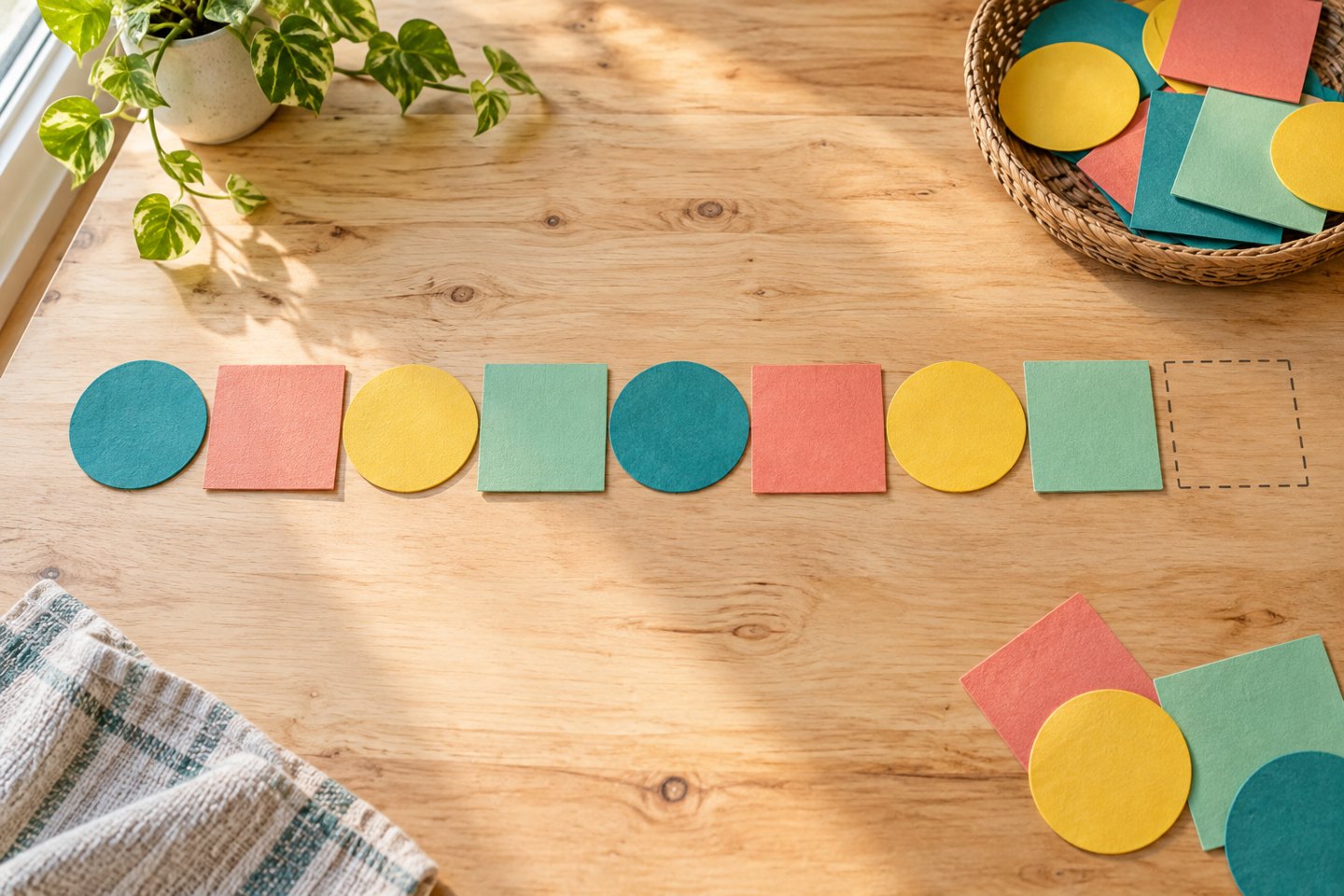
Download the finish-the-pattern worksheet
The one-page PDF includes four pattern rows, two empty answer boxes per row and a blank row for creating a pattern. Print on US Letter paper or use ‘Fit to page’ on A4. You will also need a pencil; optional large paper circles, squares and triangles let children build answers before drawing them. No signup is required.
1. Say the shapes and find the repeating unit
Point to the first row and read it together: circle, square, circle, square, circle, square. Ask, ‘Which little group keeps coming back?’ Slide a finger under the first circle-square pair, then under the next pair. Children can name the shapes, point, or use their own consistent labels. The useful part is noticing the order.
2. Build before you draw
Put large paper shapes below a worksheet row and copy it from left to right. Leave extra shapes nearby so the child can choose what comes next. Invite them to check by saying the sequence again, then draw the chosen shapes in the two boxes. Use large pieces and supervise children who mouth materials; buttons or other tiny counters are unnecessary.
3. Turn a pattern into sounds or movements
Replace circle with a clap and square with a tap on the table. Perform clap-tap, clap-tap, clap-tap, then pause for the next two actions. For a three-part unit, try clap-tap-wave. Keep the actions comfortable for the child and offer seated alternatives. Return to the paper row and notice how the same order can be represented in a different way.
4. Find and repair a mixed-up pattern
Build a short circle-square pattern, then deliberately put two circles together where the square should be. Say, ‘I wanted this pair to repeat. Does my row follow that plan?’ Let the child move a piece to repair it. State the intended rule first: without a rule, an unusual sequence is not automatically a mistake.
5. Create a pattern for someone else
Use the blank row to draw a short unit twice and leave spaces for another person to continue it. Begin with two shapes, then try a three-shape unit if wanted. Ask the creator to explain the rule after the other player finishes. This makes checking the answer a conversation rather than a hidden adult decision.
Worksheet answers and a useful teaching detail
The next two shapes are: row 1, circle then square; row 2, circle then circle; row 3, circle then triangle; row 4, circle then square. Row 2 repeats circle-circle-square. Row 3 repeats circle-triangle-square. Row 4 repeats circle-square-circle, so two circles meet where one unit ends and the next starts. Show those unit boundaries if the row seems surprising.
If a row is frustrating, cover the others and return to a two-shape pattern with movable pieces. There is no need to finish the page in one sitting. You can also use our free printable shape cards for naming and matching, or explore number order with counting cards from 1 to 10. The worksheet is free for personal and classroom use.