Simple activities. Colorful little moments.

Free Printable Shape Cards: 5 Hands-On Activities for Kids
Download six free printable shape cards and try five hands-on activities, including matching, tracing, picture building and a simple shape hunt.

These printable shape cards give you six simple pictures to use in hands-on play: a circle, square, triangle, rectangle, oval and diamond. You can match them, trace them or use them as prompts for a picture. Start with a couple of familiar shapes and add more when your child wants a new challenge.
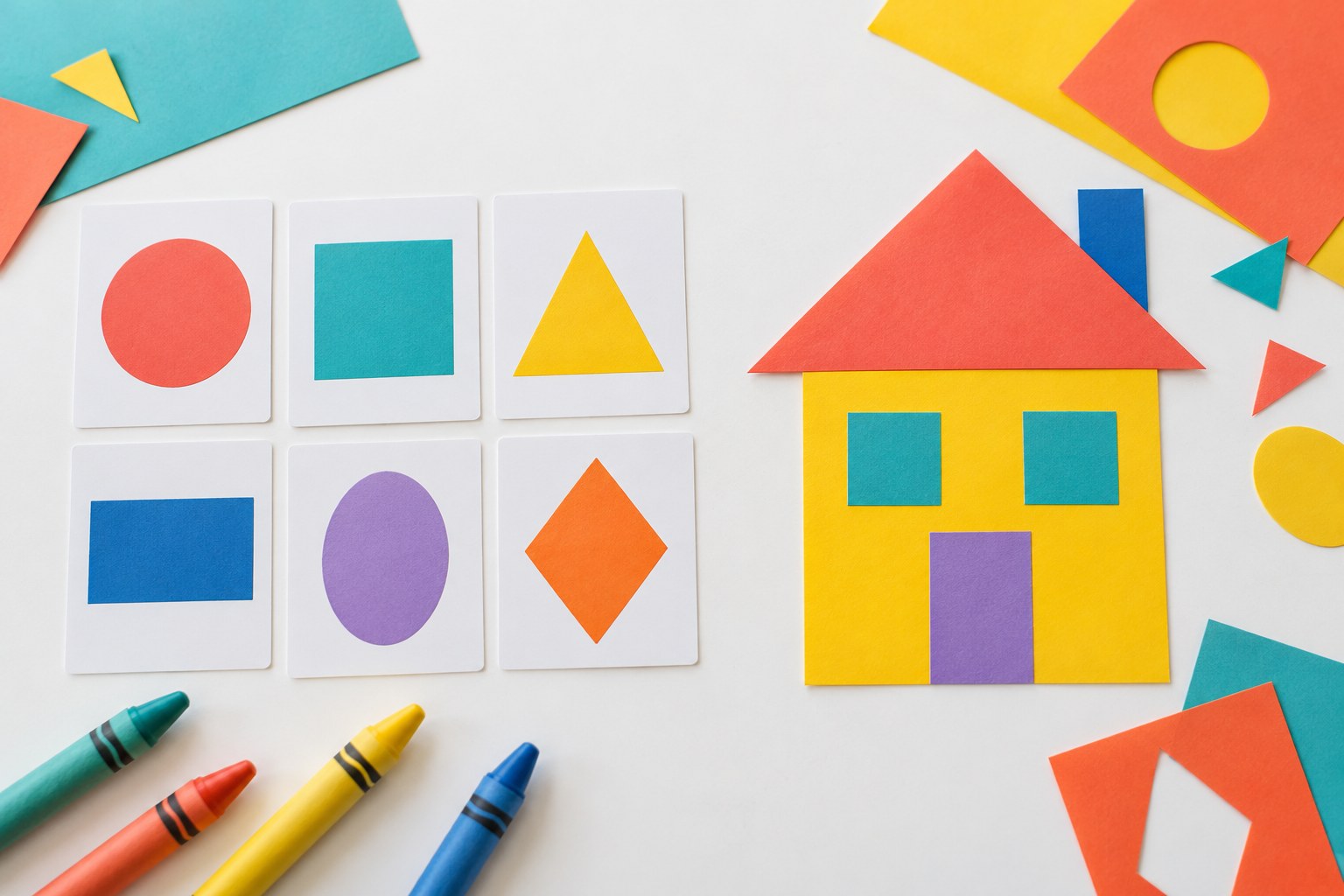
Get the free printable shape cards
Print the one-page PDF on letter paper, or use your printer’s fit setting for A4. Keep the page whole for pointing and tracing, or cut out the six cards. If you want a matching set, print it twice. The shapes have pale fills and dark outlines, and they remain usable in black and white.
Set out paper and crayons alongside the cards. For picture building, prepare a handful of large colored-paper shapes. Use materials appropriate for the child and have an adult do any cutting that is too difficult. There is no need for small counters or special manipulatives.
1. Match two pictures
Place two different cards in front of your child and offer one matching card from a second copy. Ask which picture is the same. Rotate one of the matching cards and compare again. The square is still a square when it is turned. Keep the conversation about what you can see rather than turning every choice into a quiz.
2. Trace around the outline
Leave the cards uncut and follow a large outline with a finger. Then try tracing it with a crayon on a spare printout. Talk about straight edges, corners and curved lines in ordinary language. The goal is to explore the picture, not to produce an exact tracing. If a crayon slips outside the outline, continue or switch back to finger tracing.
3. Build a picture from paper shapes
Choose a square and triangle to suggest a house, or combine circles and rectangles into a train. Arrange the pieces before adding glue so your child can move them around. Keep the reference cards nearby without requiring the finished picture to match a sample. Ask what else the same pieces could become.
4. Go on a look-and-point shape hunt
Choose one card and look around the room for something with a similar outline. A book cover may look rectangular; the face of a wall clock may look circular. Point to objects rather than taking them down. Explain that you are comparing the flat outline you can see: a ball and a circle are not the same kind of shape, even though a ball may remind you of a circle.
5. Sort by one feature
Lay out the six cards and choose one sorting question: which pictures have straight edges, and which have curves? Try another arrangement by grouping pictures with four straight sides. Let a child explain an unexpected grouping; they may be sorting by another feature. Change only one sorting rule at a time.
A note about the diamond card
“Diamond” is a familiar everyday label for the slanted four-sided picture in this set. You can use that word during play and introduce “rhombus” when it fits what the child is learning. The set is an activity aid rather than a complete geometry curriculum, so there is no need to rush into formal definitions.
Keep the next session short and familiar
Repeat a favorite activity before introducing another. Two cards and five minutes of shared play may be plenty; follow the child’s interest rather than completing all five ideas. Store cut cards flat in an envelope. For a related number activity, use our free counting cards. For a room-based game with broader prompts, try the indoor scavenger hunt.
[…] the same comparisons to three familiar nesting containers, or explore more shape names with our free printable shape cards. End with a successful comparison and return to harder arrangements another […]