Simple activities. Colorful little moments.

Accordion Paper Animals for Kids: An Easy Folding Craft
Make accordion paper animals with a single folded strip. Follow clear folding steps, add a caterpillar or dog face, and fix folds that twist or flatten.

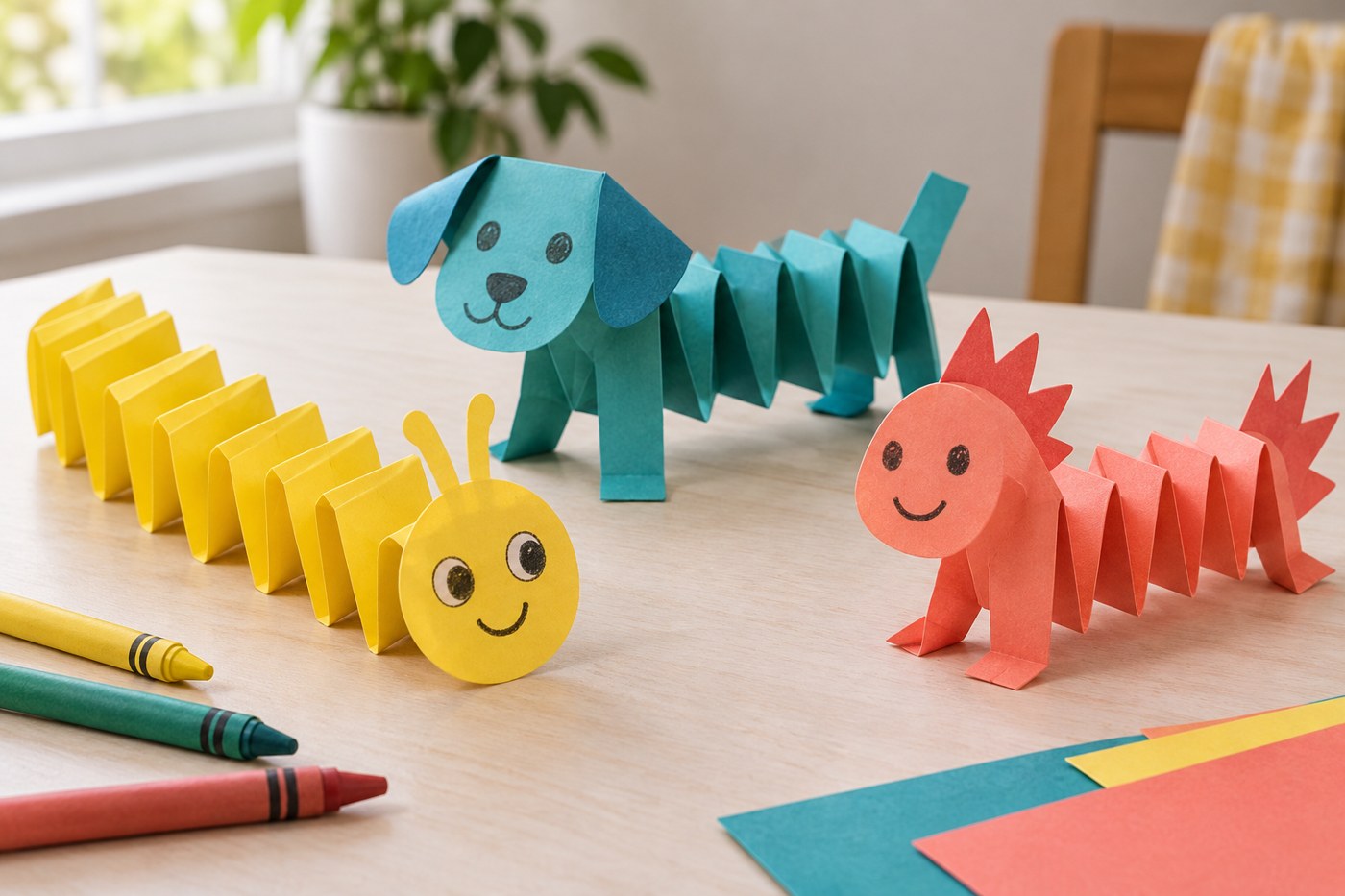
Accordion paper animals use one strip folded back and forth into a concertina. Add a paper face at one end and the folds become a caterpillar, a long dog or an imaginary creature. The basic version rests on the table; it does not need to stand on tiny legs.
Allow around 20 minutes for cutting, folding and decorating. Start with one animal rather than a set. An adult can prepare the strip and help with the first two folds, leaving the child to choose the face and colors.
Materials and a useful starting size
Gather colored paper, scrap paper for the head, a glue stick, crayons, a ruler and suitable scissors. A strip about 6 cm wide and 28 cm long makes a manageable first animal. These are starting dimensions, not a precision requirement. Ordinary paper folds more readily than thick card.
Draw eyes and details instead of adding small loose decorations. Have an adult handle cutting where needed. The generated picture shows decoration possibilities; the instructions below make a simpler tabletop animal without requiring the illustrated legs or exact proportions.
Fold one strip, back and forth
Place the strip vertically in front of you, with a short edge nearest you. Fold that near edge away from you by about 2 cm and crease it. Turn the whole strip over from left to right, keeping the folded short edge nearest you.
Fold the stacked short edge away from you again by approximately the same amount. Turn the strip over again and repeat: fold, turn over, fold. The growing stack stays at the near end. Stop when there is only a small leftover section; trim that section or make it the final flap.
Open the stack gently. Seen from the side, the paper should zigzag rather than roll into a spiral. If it rolls, unfold the last few creases and reverse every other one. You are folding one strip, not interlocking two strips.
Make a caterpillar face
Cut a paper circle roughly as wide as the body strip. Draw two eyes and a mouth. Glue only a small portion of the face to the first end panel of the accordion, keeping glue away from the next crease.
Lay the zigzag body on its long edge or let it rest partly flattened on the table, whichever is stable. The face can lie forward slightly. Draw antennae on the face or add broad paper antenna shapes; they are optional. Let the join dry before opening and closing the body.
Turn the same fold into a dog
Make a rounded head with two broad paper ears and draw a nose. Attach it to the end panel just as for the caterpillar. Add a small flat tail to the opposite end. Keep the head light enough that it does not pull the whole strip flat.
You can draw paws on the lower edges of the body panels. Freestanding legs are not needed. For a creature with a different personality, change only the face: wide eyes, a beak or a smiling triangle can suggest a new animal without rebuilding the body.
Fix the common folding problems
Uneven folds: line up each new fold with the previous panel rather than measuring every crease. A slightly irregular accordion still works. Twisting: place the strip flat, straighten the edges and re-crease the last two panels.
Body will not stay open: relax the stack slowly instead of pulling its ends hard. A heavy face: remake it from lighter paper or glue the whole animal to a background sheet as a raised collage. A torn crease: reinforce it from the back with a little paper tape.
Use the animals in a short story
Choose two characters and one event, such as arriving at a garden or looking for a missing leaf. Move them by holding a body panel, not pulling the glued face. Put the dry animals in a shallow box between sessions.
For another folding project, try paper weaving. If the child enjoys voices and characters more than folding, our paper bag animal puppets provide a different way to make a show.