Simple activities. Colorful little moments.

Construction Party for Kids: A Simple At-Home Activity Plan
Plan a construction party for kids with cardboard buildings, a paper bridge challenge and a shared town. Includes supplies for six guests and timings.

A construction party for kids can revolve around building a shared cardboard town instead of buying a large set of themed decorations. This plan suits a small group of six children working at a table, with adults adapting cutting and assembly to their abilities. The suggested 60 minutes cover activities and tidying; add a separate break for any food or cake.
Prepare a manageable kit for six guests
Gather twelve small clean cardboard boxes, twelve sheets of paper, six crayons or crayon sets, three rolls of paper tape, six broad card strips and a large base sheet. Add a few age-appropriate toy vehicles if available. Children can push a folded-paper bus instead if there are no toy trucks.
Before guests arrive, remove staples, loose plastic and rough packaging. Adults should make any window or door cuts in advance. This is a tabletop model-building activity: the structures are not for climbing, standing or carrying children. Skip real tools and heavy building materials.
Arrange three work areas
Put boxes and drawing materials at the building area, paper strips and pairs of low blocks at the bridge area, and the large base sheet at the town area. Leave room between stations so children do not need to lean across other people’s work.
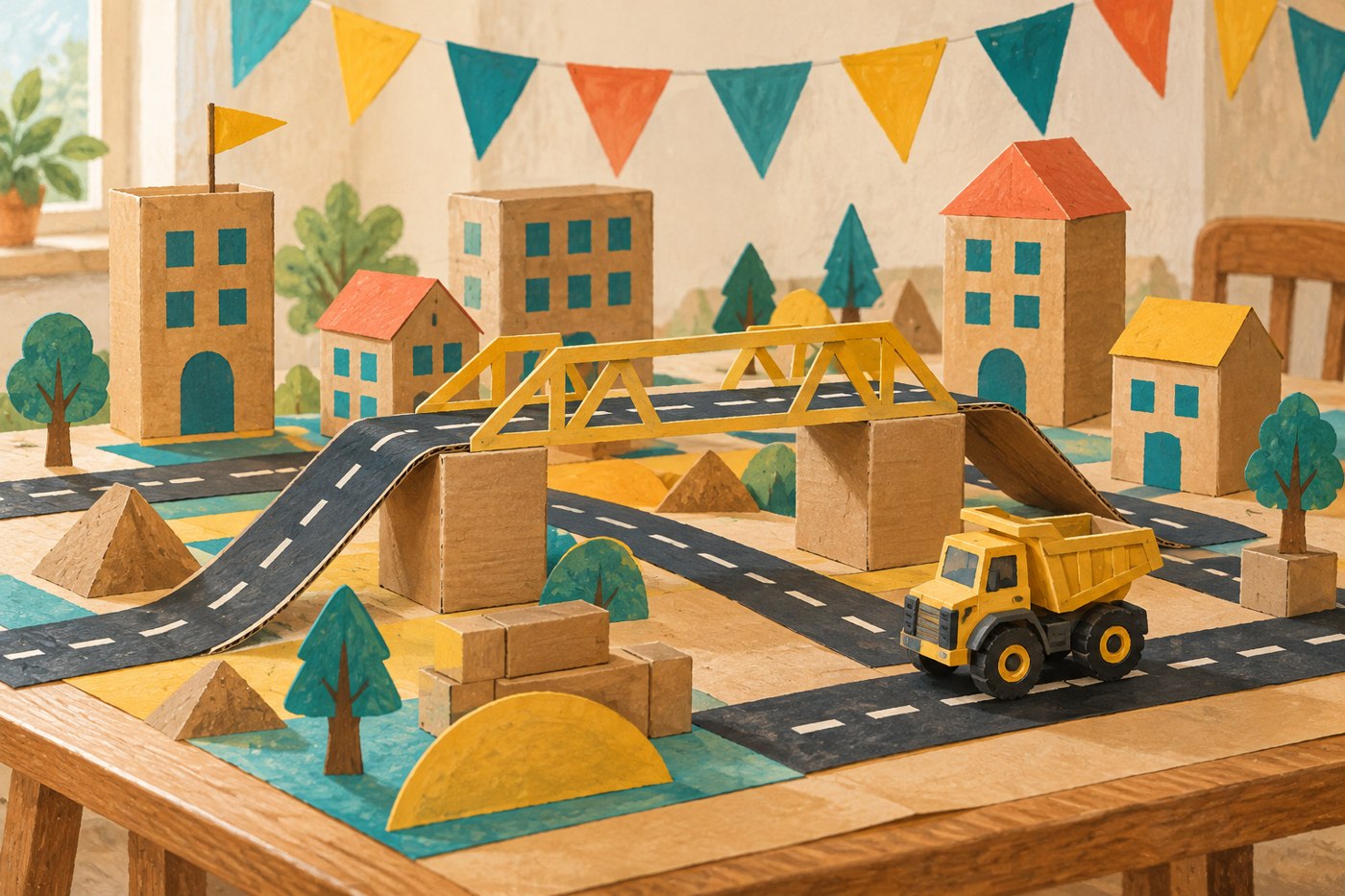
Keep a basket for unused materials and a separate scrap container. Place one simple example on the table, but explain that houses, shops, garages and imaginary buildings are all welcome. The generated illustration shows an elaborate town; your version can begin with a few undecorated boxes.
Use a flexible 60-minute schedule
Allow 10 minutes for arrivals and drawing a building sign, 15 minutes for decorating boxes, 10 minutes for the bridge challenge, 15 minutes for arranging and playing with the town, and 10 minutes for sharing and tidying. Keep a quieter drawing place available for anyone who wants a break.
If guests are absorbed in the buildings, shorten the bridge segment or omit it. Avoid interrupting a useful activity only to keep the schedule exact. Assign adults to support the busiest station rather than rotating children on a whistle.
Try a paper bridge challenge
Place two low blocks about 10 cm apart and lay a broad card strip across them. Test it with one lightweight paper vehicle. If it bends, try moving the supports closer or folding both long edges upward to make shallow sides. Use the same vehicle when comparing designs.
Ask “What could we change?” before demonstrating a solution. The point is to try a revision, not to declare one child the best engineer. Do not add increasingly heavy objects, and keep the bridge at tabletop model scale throughout.
Connect the buildings into one town
Invite each builder to choose a place on the base sheet. Draw roads between buildings, leaving some space for a park or open area. Ask which buildings need a route to each other. A garage might need a road to the bridge; a shop might need a place for deliveries.
Give children a reason to move through the town: deliver a paper letter, take a bus to the library or repair a pretend road. Offer roles such as driver, map-maker and building owner, with easy swaps. Everyone can join without competing for the same truck.
Finish without dismantling someone’s work unexpectedly
Before building begins, explain whether models will go home or remain in the shared town. At the end, let each child describe one feature. Ask before separating joined structures. Photographing the model is optional; it is not needed to make the activity complete.
Use our cardboard building ideas for another session. The pretend post office can supply a delivery game for a town you keep.