Simple activities. Colorful little moments.

5 Cardboard Building Activities for Kids Using Empty Boxes
Turn empty boxes into bridges, towers and a miniature town with five cardboard building activities for kids, plus setup tips and easy adaptations.

Cardboard building activities for kids turn a few empty boxes into an open-ended afternoon of making. Start with one small challenge, such as building a bridge for a paper car, and let children decide what happens next. These five ideas use familiar supplies and work on a table or a clear patch of floor.
Gather a small building kit
Set out clean cereal boxes, small delivery boxes, cardboard tubes, masking tape, crayons and scrap paper. Choose cardboard that is easy to bend. An adult should remove staples, plastic packing and sharp edges before play, and handle any cutting that needs a craft knife. Keep structures at model size: these projects are not designed to support a child’s weight.
You do not need all five activities at once. Put a handful of pieces in a tray and save the rest for later. Fewer starting materials can make the first decision easier, and a tray gives unfinished creations somewhere to stay between sessions.
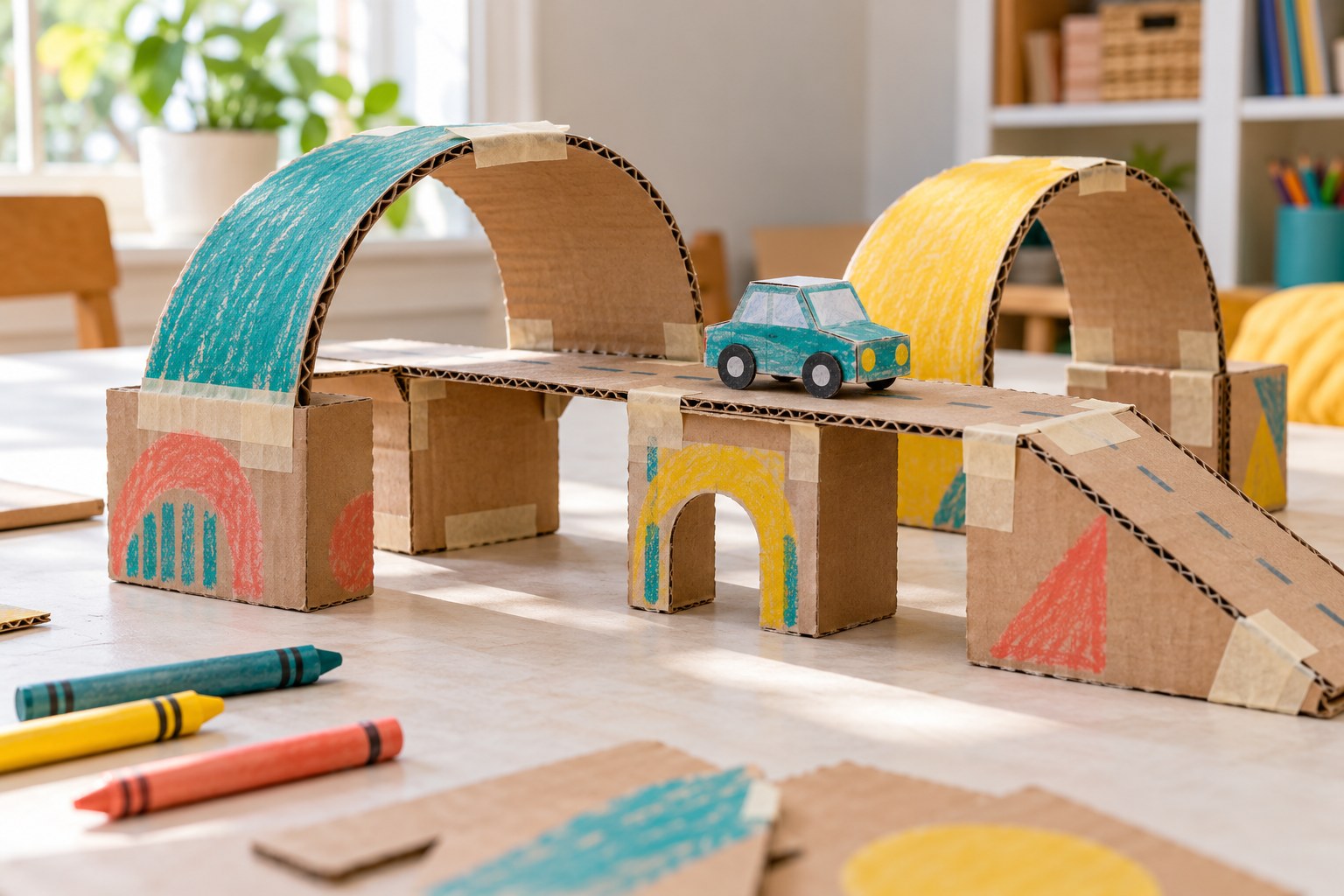
1. Build a bridge between two boxes
Place two small boxes a short distance apart and lay a strip of cardboard across them. Roll a paper car across the bridge. If the middle sags, ask what might help: moving the supports closer, adding another layer or folding the bridge deck into a shallow channel. Change one thing at a time so you can compare the result. Use a paper car or another light object rather than stacking heavy weights.
2. Make a tower with a doorway
Stack three or four light boxes, starting with the widest base. Give the tower a doorway drawn on scrap paper. Add another floor only when the lower layers stay upright. If it topples, rebuild it with a different arrangement. Try the same boxes in two orders and talk about which arrangement feels steadier. The rebuilding is part of the activity, not a mistake to fix for the child.
3. Create a miniature neighborhood
Turn small boxes into a library, a home and a shop. Draw windows, tape on folded-paper roofs and place the buildings along a road drawn on a large sheet. Leave room for a park or an idea your child invents. Extend the play with paper characters and a short story: someone needs to return a book, find a lost pet or visit a friend.
4. Design a garage with parking spaces
Use a shallow box as the base. Add folded-cardboard dividers and draw a road leading inside. Make paper vehicles of different widths, then check which spaces they fit. Younger children can match vehicles to spaces without counting; older children can label bays or draw a simple parking map. Keep ramps low so the garage remains easy to reach.
5. Build a creature from offcuts
Choose a box for the body and folded strips for legs, wings or a tail. Tape the parts together and draw the face directly onto the cardboard. Ask where the creature lives and what it likes to do. This is a useful final challenge because odd-shaped leftovers become features rather than waste.
Adapt the challenge and finish without a fuss
For younger makers, pre-cut a few large pieces and tear tape into short lengths. For children who want a harder challenge, set a clear constraint: use only four pieces, make a removable roof or build something that folds flat. Avoid turning the task into a race unless everyone wants one.
Take a photo of a favorite creation before recycling it, or keep one model on a shelf. Sort reusable pieces into a box and discard torn scraps. If you need a quieter follow-up, try our torn paper flower craft. For more indoor choices, browse rainy-day activities using everyday supplies.
Do you need to buy a building kit?
No. A couple of clean boxes, paper and tape are enough. Start with the bridge or miniature neighborhood, then add materials only when a child’s idea calls for them.
[…] box is easier to pass around than a large construction. For more practical assembly ideas, use our cardboard building guide. Take a short pretend journey once the rocket can stand or lie securely on the […]