Simple activities. Colorful little moments.

Tic-Tac-Toe Variations for Kids: 5 Ways to Reuse One Board

These tic-tac-toe variations for kids use the familiar three-by-three grid in different ways. Start with the ordinary game, then choose one variation at a time so the new rule is easy to remember.
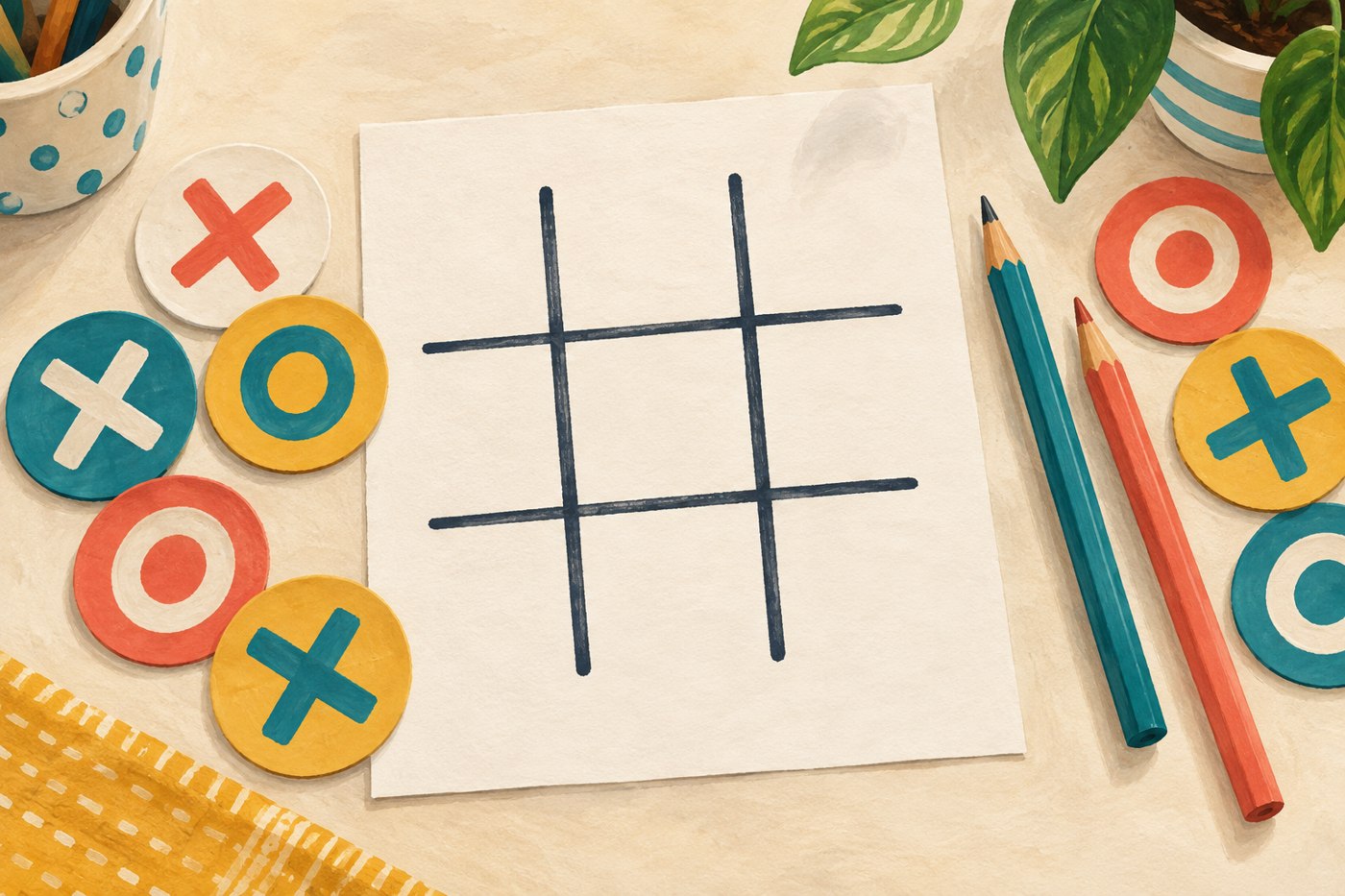
Draw two vertical and two horizontal lines on paper, or use our free printable tic-tac-toe boards. For reusable play, use large paper squares marked X and O. Keep small counters away from children who may put them in their mouths.
First, agree on the regular rules
Two players take turns marking one empty square. One uses X and the other O. Three matching marks across, down or diagonally win. If all nine spaces fill without a line, the game is a draw.
Many games between experienced players end in draws. That does not mean the game is broken. The variations below change the question or the turn structure, rather than promising a winner every time.
1. Cooperative line builders
Both players work together to make a specified pattern. Choose “three Xs diagonally” or “three Os down the left side.” Take turns placing the agreed symbol, describing where it should go. Stop when the pattern is complete.
This is a grid-position activity rather than a competitive game. For a second round, ask one player to describe a target without pointing: “top left, middle and bottom right.” Switch who gives directions.
Make it easier by showing the target on a second board. Make it harder by describing two different lines that share the center square.
2. Three-piece moving tic-tac-toe
Give each player three large paper counters. Take turns putting one counter in an empty square. A line of three wins during this placement stage too. If all six counters are placed without a winner, begin the moving stage.
On each turn, move one of your own counters to an empty square directly above, below, left or right of it. Diagonal moves are not allowed in this version. Only one counter moves per turn, and three in a row still wins.
Agree to call a draw after twenty moves in the moving stage, or sooner if the same position keeps returning. State this limit before starting so the game has a clear ending.
3. Mystery-start puzzles
An adult prepares a position with two Xs in a row and the third space empty, then asks, “Where can X win on this turn?” Start with an otherwise empty board. Let the child point rather than write if preferred.
Next, put two Os in a row and explain that it is X’s turn. Ask where X could play to stop O winning next. Avoid filling the board with random marks: use positions with sensible turn counts and no line already completed.
Have the child create a simple puzzle for the adult. Explaining which player moves next is part of making a puzzle another person can solve.
4. Draw-your-own-symbol rounds
Replace X and O with two quick symbols: a sun and a leaf, for example. Each player chooses one symbol and uses it throughout the round. Keep the ordinary rules.
Allow a few moments to draw each turn and keep the symbols clearly different. A spiral and a circle can become confusing; a triangle and a star are easier to distinguish.
If drawing slows the game too much, prepare three or four large paper tokens per player before starting. For a separate drawing game, try our draw-and-guess cards.
5. The explain-and-rematch game
Play a normal round, but pause before each move. The player may explain “I am making a line,” “I am blocking your line,” or “I am trying this square.” Saying “I am not sure yet” is also allowed.
After the round, choose one moment to replay on a fresh board. Ask what would happen with a different move. Keep it curious rather than correcting every choice.
Switch who starts for the next round. Stop after two or three games if the discussion is more tiring than fun.
Choose a variation for the moment
Use cooperative line builders when competition is unwelcome. Choose moving counters when children know the normal game and want a new rule. Try mystery starts for a short one-player puzzle with an adult. Drawn symbols work well when decorating is half the appeal.
Do not combine all five versions at once. A small rule change is easier to enjoy when everyone can explain it before play begins.
Common questions
Can we play without printing? Yes. Draw a grid on scrap paper and use pencil marks or large paper tokens.
What if a child keeps losing? Try cooperative play or offer to think aloud during a normal round. Avoid secretly changing the rules halfway through.
Does moving-piece tic-tac-toe have one official rule set? Several versions exist. The adjacent-move rules above define this particular home-play version.