Simple activities. Colorful little moments.

Free Printable Tic-Tac-Toe: Six Boards and Simple Rules
Download six free printable tic-tac-toe boards. Learn the rules, practice spotting a winning move and use a simple routine for fair rematches.

This free printable tic-tac-toe sheet contains six blank boards, enough for a short two-player session without drawing a fresh grid each time. The aim is to make a line of three matching marks before the other player does. The boards are deliberately plain: children can focus on where to place a mark rather than on a themed background.
Download and print the six-board sheet
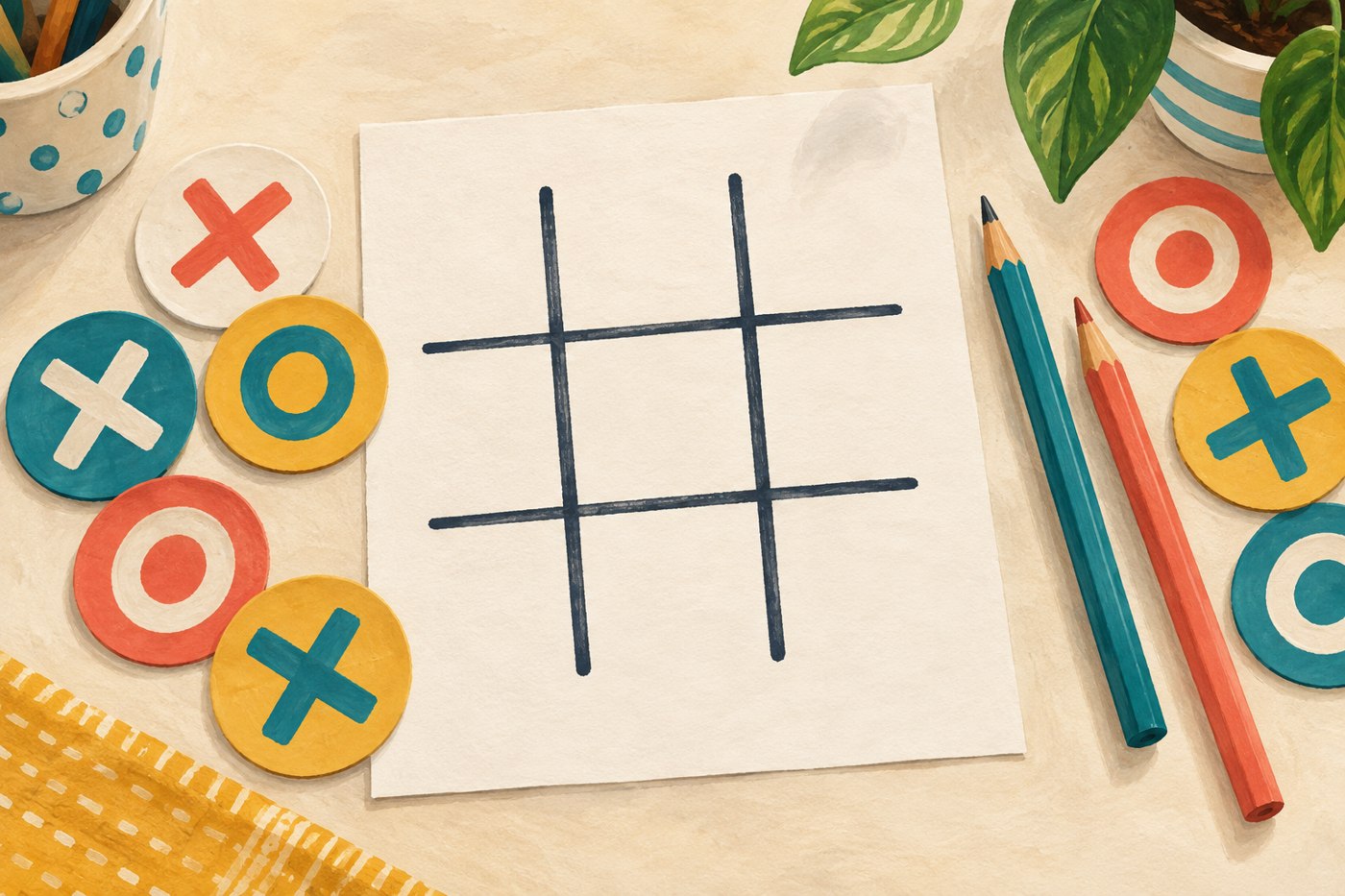
The one-page PDF has six three-by-three boards arranged in two columns. Print on US Letter paper, or select Fit to page for A4. Use pencils or crayons; no cutting is required. The generated picture is an illustration, while the preview below shows the actual file.
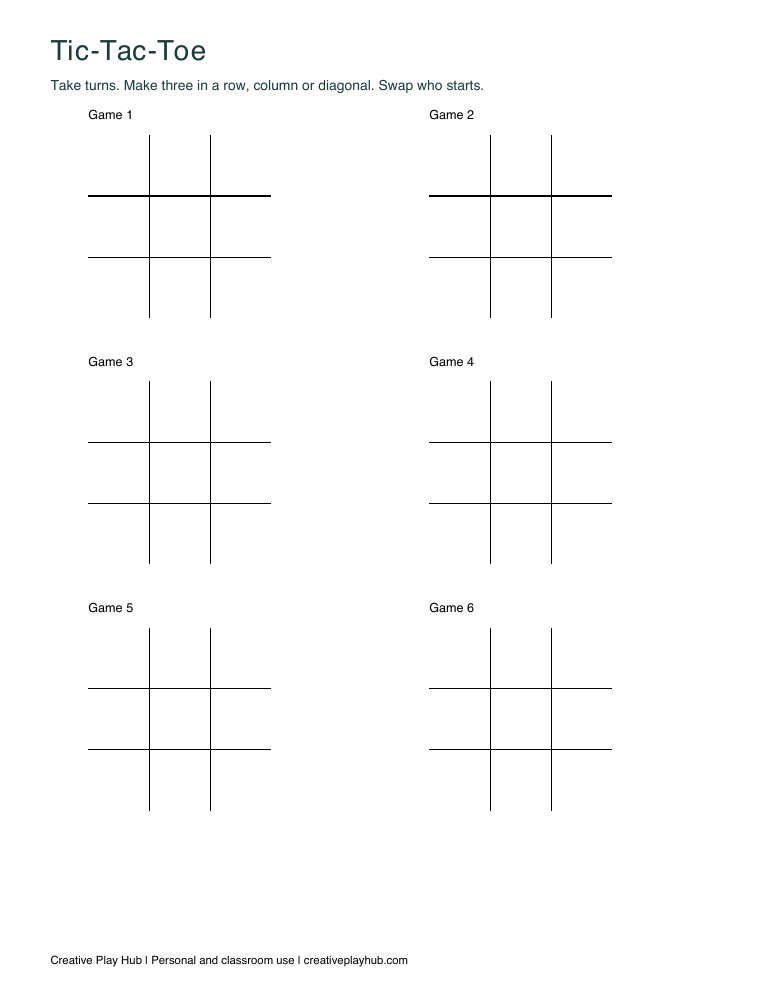
Choose one board for a first game and cover the others with scrap paper if the page feels busy. For repeated use, place the sheet in a reusable wipe-clean sleeve and use a suitable erasable marker under adult supervision.
Agree on the rules before the first turn
One player uses X and the other uses O. Pick who starts, then alternate placing one mark in an empty square. Marks stay where they are; players cannot move them later or put two marks in one square. Each board begins completely empty.
A player wins immediately when three of their marks form a horizontal, vertical or diagonal line. If all nine squares fill without a winning line, the result is a draw. Stop when someone wins; there is no need to finish filling that board.
Show a winning move on a practice board
Draw X in the top-left and top-middle squares. Draw O in the middle-left and center squares. It is now X’s turn, since each player has made two moves. Ask where X can go to finish a line. The top-right square completes the top row and wins.
Then clear the example or use another board. Explain that looking for an immediate win comes before blocking an opponent. In that example O also threatens the middle-right square, but X can end the game by completing the top row first.
Practice looking before placing a mark
On a new turn, ask two short questions: “Can I complete three?” and “Can the other player complete three next?” Let the child point before drawing. Avoid giving a long strategy lecture in the middle of a game; one visible line is enough to discuss.
If a player misses a chance, decide together whether this is a practice game with take-backs or a game where placed marks stay. Agree at the start and apply the same rule to both people. A relaxed practice board can be separate from the scored games.
Make rematches fair and manageable
Swap who starts on each new board. Play two boards, pause and decide whether to continue; six printed spaces do not create an obligation to use them all. You can record a win with a small initial beneath a board and a draw with a dash.
Repeated draws are a normal outcome when both players spot the threats. Try describing one interesting move together instead of treating a draw as a failed game. Keep the emphasis on noticing the board rather than on playing quickly.
Keep a small pencil-game folder
This printable is free for personal and classroom use. Share this article link with other families instead of selling or redistributing the file. Store a few copies with two pencils for quiet play at home.
For another two-player pencil game, use our dots and boxes printable. For a drawing game with a different pace, try draw and guess cards.
[…] two vertical and two horizontal lines on paper, or use our free printable tic-tac-toe boards. For reusable play, use large paper squares marked X and O. Keep small counters away from children […]