Simple activities. Colorful little moments.

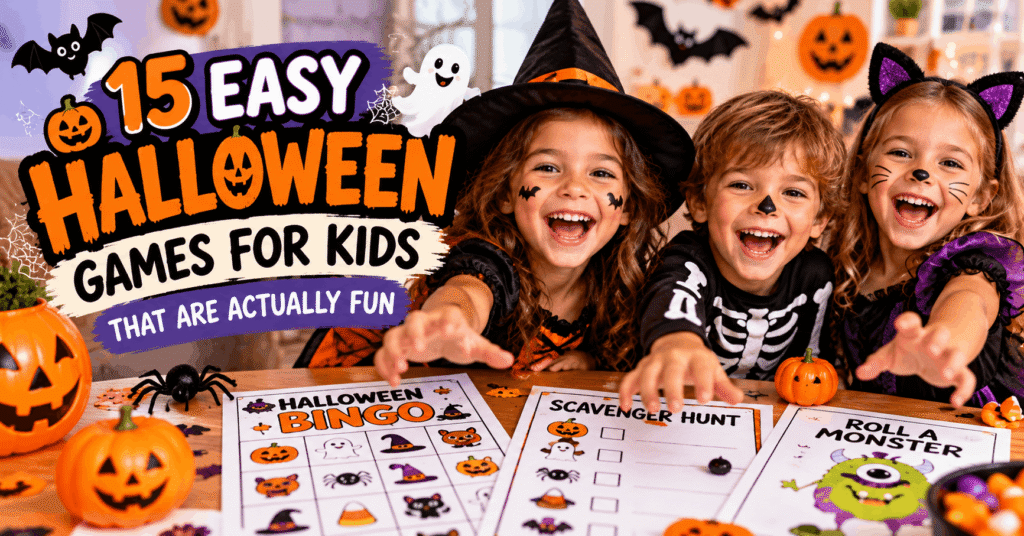
15 Easy Halloween Games for Kids That Are Actually Fun

Choose a few of these Halloween games for kids for a classroom celebration, a family afternoon or a small party at home. Each idea includes supplies and rules so you can prepare it without inventing the whole game yourself. Most use paper, crayons or familiar household items.
For a mixed group, start with two active games and one quiet table activity. The timings below are planning estimates; shorten a round or repeat a favorite to suit your children. Adults should check materials, supervise play and offer a way to join in without competing.
Updated October 27, 2026: clearer instructions, gentler game options and links to existing printable resources.
Choose games for your space
Small room or seated group: bingo, the missing-item tray, would-you-rather and roll a monster. Room to move: scavenger hunt, bowling, freeze dance and target toss. No printer: all 15 games can use hand-drawn materials or no paper at all.
Choose large materials for children who mouth objects, and let an adult handle cutting. Keep paths clear, avoid open flames, and do not use candy as game counters. Offer friendly themes and a quiet break to children who dislike surprises. These are adaptable activity ideas, not a claim that every game has been physically tested with every age group.
1. Halloween Scavenger Hunt
Supplies: paper, crayons and six large paper pictures. Time: 5–10 minutes. Players: one child or a small group.
Draw a pumpkin, ghost, bat, hat, moon and black cat on separate sheets. An adult places them in visible, reachable spots in one agreed room. Draw the same six pictures on a checklist. Children walk around and point to each match or tick it off; leave the pictures in place so everyone can find them.
For younger children, search for three pictures together. For older children, add a clue such as “The moon is near something you sit on.” Keep the route away from stairs, doors and places that require climbing. Our indoor scavenger hunt printable offers a ready-made, non-Halloween alternative.
2. Make-Your-Own Halloween Bingo
Supplies: paper and crayons. Time: 10 minutes of preparation, then 5–10 minutes to play.
Draw a 3-by-3 grid for each player. Choose nine symbols: pumpkin, moon, bat, ghost, cat, hat, leaf, star and spider. Put all nine on each board in a different order. Make nine matching caller slips. An adult draws one slip at a time and names or shows it; players cross out that picture with a crayon.
Agree before starting that a row of three across, down or diagonally counts as bingo. Check the row against the called slips. Continue for a full-board game if the group wants to. Crayons avoid loose counters or candy pieces. For boards you can download now, try our picture bingo set; its pictures are not Halloween-themed.
3. Cardboard Mummy Challenge
Supplies: a large cardboard person shape, torn paper strips and a glue stick. Time: 10 minutes.
An adult cuts a simple cardboard figure. Place it flat on a table. Children lay and glue short strips across its body, leaving space to draw a face. Work together on one figure or give each child their own. The challenge is to cover the cardboard with overlapping patterns, rather than finish fastest.
Keep the wrapping on the cardboard: do not wrap children, pets or anyone’s head, neck or limbs. Younger children can tear and press down strips while an adult handles the cutting. Display the finished mummies together without choosing a “best” one.
4. Place the Hat on the Witch
Supplies: a large witch drawing, paper hats and removable tape. Time: 5–10 minutes.
Tape the drawing at a comfortable reaching height. Give each player a paper hat with a small loop of tape on its back. Players take turns walking to the picture and placing a hat on the witch. Use a different color or drawn symbol to identify each player’s hat.
Keep eyes open and skip spinning. To add a challenge, let a partner describe where the hat should go, or ask players to match a hat to a drawn outline. Play for a shared funny picture; if the group wants points, agree on a target outline first.
5. Ghost-Pin Bowling
Supplies: six clean, empty cartons, paper ghost faces and a soft ball or rolled socks. Time: 5 minutes to set up, then 10 minutes to play.
Arrange the cartons in rows of three, two and one. Mark a rolling line about one metre away, adjusting it to your space and players. Each player rolls twice, counts the fallen cartons and then helps reset them. Only retrieve the ball when the lane is clear.
Use a soft ball instead of a real pumpkin. Keep other players behind the rolling line and clear breakable objects from the area. For a cooperative game, add everyone’s score and try to match it in a second round. See our sock bowling guide for more setup options.
6. Halloween Freeze Dance
Supplies: music and a clear space. Time: 5–8 minutes.
Play a short piece of child-friendly music. When the adult pauses it, everyone makes a still pose: a tall pumpkin, a sleepy cat or a friendly monster. Start the music again after a few seconds. Explain the stop signal before beginning.
No one needs to sit out for moving. Offer seated dancing, hand movements or a quiet observer role. Keep the volume comfortable and remove trailing costume pieces or masks that obstruct movement or vision.
7. Mystery Texture Bag
Supplies: an opaque bag and large, clean objects such as a washcloth, sponge and soft toy. Time: 5–10 minutes.
An adult checks each object and places one in the bag. A willing player feels it and describes a texture before guessing: soft, bumpy, smooth or fluffy. Reveal the object, then change it for the next turn.
Skip food, sharp objects and loose small parts. Let children look first, touch through the outside of the bag or pass altogether. The surprise should be playful, not a dare. Wash or clean shared objects as appropriate, and choose materials suitable for the children involved.
8. Pumpkin Target Toss
Supplies: three large paper pumpkin targets and rolled socks. Time: 5–10 minutes.
Lay targets flat on the floor, spaced apart, and mark a throwing line. Give each player three gentle underarm tosses. Count one point when the socks come to rest touching a pumpkin. Retrieve them together after the turn.
Move the line closer or use bigger targets if needed. For seated play, put a large target within comfortable reach on a table and slide the socks toward it. Keep the landing area clear of people.
9. Halloween Charades
Supplies: six paper prompt cards. Time: 10 minutes.
Use these prompts: a cat stretching, a bat flapping, picking a pumpkin, stirring an imaginary soup, a ghost floating and putting on a costume. Read or show a card privately to the actor, who acts while the others guess. Give a clue if the group gets stuck.
Players may act with a partner, make sounds or choose a different prompt. Skip a strict timer for a first round. For more prompts with a different theme, our animal charades printable is ready to download.
10. Monster Says
Supplies: none. Time: 5 minutes.
The leader gives a movement preceded by “Monster says”: stretch your arms, wiggle your fingers or make a tiny wave. Players copy only when they hear that phrase. Demonstrate two examples before introducing a command without it.
If someone copies the wrong cue, smile and restart together instead of eliminating them. Let children lead a few turns if they want to. Offer movements that can be done seated and avoid commands involving contact with other players.
11. What Is Missing from the Witch’s Tray?
Supplies: a tray, cloth and four large objects or picture cards. Time: 5–8 minutes.
Show a paper hat, a leaf picture, a pumpkin picture and a large crayon. Name them together. Cover the tray, remove one item out of sight, then uncover it. Players identify the missing item by saying, pointing or drawing.
Start with three items for a simpler round and add more when the group is ready. Let everyone discuss the answer together. This quiet memory game provides a different activity from the target-toss game.
12. Halloween Would You Rather
Supplies: none. Time: 5 minutes.
Offer two friendly choices: wear a pumpkin hat or a cat costume; meet a dancing ghost or a singing monster; decorate a purple pumpkin or an orange one; travel on a flying broom or in a pumpkin carriage. Children can answer aloud, point left or right, or hold up one or two fingers.
There is no correct answer, and passing is fine. Invite a reason without requiring one. Keep everyone seated if space is limited, and let players invent the next pair of choices.
13. Estimate the Paper Pumpkins
Supplies: a sheet with a group of drawn pumpkins, paper and crayons. Time: 5–8 minutes.
Before play, draw 12 pumpkins scattered across a sheet and keep the count to yourself. Show it briefly, then let children guess how many they saw. Reveal the sheet again and count together, pointing to each pumpkin once.
Use five pictures for a simpler version or draw a larger group for another round. Compare guesses without awarding food or small prizes. This keeps the estimating activity focused on looking and counting rather than handling a jar of candy.
14. Roll a Monster
Supplies: blank paper, crayons and a large die used with adult supervision. Time: 10 minutes.
Draw a large body shape first. Use this key: 1 = add an eye; 2 = add a mouth; 3 = add a horn; 4 = add an arm; 5 = add a leg; 6 = add an accessory. Take six rolls, adding one feature per roll. Repeated numbers add another of that feature, so a monster might have several eyes and no legs.
After six rolls, add any missing features you want and give the monster a name. For a no-dice version, an adult calls numbers or children choose them. Our roll-a-creature printable is another drawing game; follow the rules printed with that resource.
15. A Three-Clue Halloween Treasure Hunt
Supplies: three clue slips and a final envelope containing a drawing prompt or party message. Time: 10 minutes to prepare and 5–10 minutes to play.
Use one room with a chair, a book and a drawing area. Hand over clue one: “Look where we sit to hear a story.” Put clue two on the chosen chair: “Find the book with a paper pumpkin on its cover.” Place that marked book within reach, with clue three inside: “Your surprise waits where we draw.” Put the final envelope at the drawing table.
Check the full route before starting and tell children which room they may search. Read clues aloud and walk together. Do not hide clues near medicines, cleaning products, electrical equipment or climbing spots. For a group, give different children a turn to carry or read the next clue.
A simple 45-minute Halloween party plan
0–5 minutes: welcome everyone, explain the play area and choose a quiet-break spot. 5–15: run the picture scavenger hunt. 15–25: play ghost-pin bowling, taking turns. 25–30: pause for water and a reset. 30–40: draw roll-a-monsters. 40–45: share drawings if children want to and tidy together.
Prepare the picture cards and cartons before guests arrive. For a larger group, use small supervised stations rather than one long queue. If you have fewer adults or limited space, replace bowling with a seated game. Keep an extra drawing sheet available for anyone who finishes early.
Printable resources available now
The linked resources are existing downloads with their own themes and instructions; they are not a Halloween printable pack. Choose picture bingo, an indoor scavenger hunt, animal charades or roll a creature. Open the relevant article for its PDF download and usage notes.
Questions before you start
Which games need the least preparation? Freeze dance, Monster Says and would-you-rather need no printed materials. Charades only needs a few handwritten prompts.
How do I adapt these for younger children? Use fewer pictures, shorter rounds and an adult partner. Keep matching materials visible, demonstrate one turn and allow pointing instead of reading or writing.
Can the whole group play without winners? Yes. Find pictures together, combine bowling scores, or make a shared monster gallery. Passing or watching a round is also a valid way to take part.
Have a question or spotted a problem with these instructions? Email contact@creativeplayhub.com with the article title. Read our publisher information and activity disclaimer.