Simple activities. Colorful little moments.

Indoor Sock Bowling for Kids: A Simple Six-Pin Game
Set up indoor sock bowling with six empty cartons and rolled socks. Includes simple rules, scoring, space adjustments and a cooperative version.

Indoor sock bowling turns six empty cartons and a pair of rolled socks into a short turn-taking game. The useful part is how easily you can adjust it: move the start line, spread the pins or play together toward one shared total. Allow about ten minutes to set up and another ten to fifteen minutes for a first game.
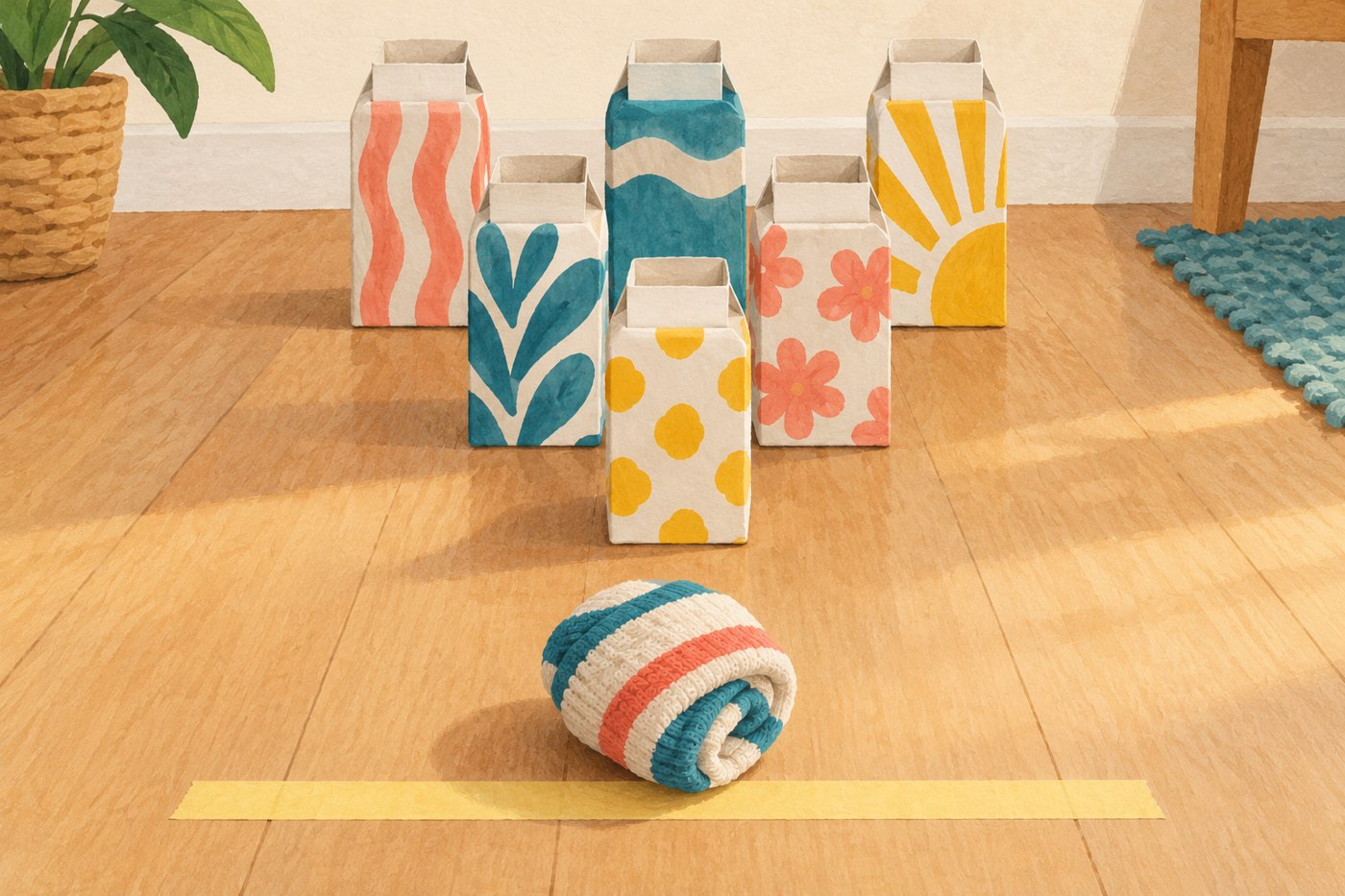
Gather six light pins and one soft ball
Use six clean, dry, empty drink cartons of similar size, one pair of soft socks and a strip of removable paper tape. Roll the socks together without adding anything inside. Remove caps and loose packaging. Cartons need flat bottoms so they stand without being weighted; do not fill them with water or other heavy material.
Choose a level floor with a clear lane away from stairs, glass, pets and passing feet. Test the tape on an inconspicuous area first. On a slippery floor, play seated with the socks rolled forward from the floor rather than asking children to run up. An adult should handle any preparation that involves cutting packaging.
Set up a lane that fits your room
Arrange the cartons in a triangle: one at the front, two behind it and three in the back row. Leave a small gap between neighboring cartons. Start with the rolling line roughly one adult step from the front pin. Try a gentle roll yourself; if the socks stop well short, shorten the distance.
Keep spectators beside the starting area, outside the lane. Decide who resets the pins before play begins. Nobody retrieves socks or stands pins up until the rolling player has finished and the lane is clear. This simple pause makes a small room much easier to manage.
Play a two-roll turn
Each player has two rolls. After the first, leave fallen pins down. After the second, count the total number knocked over, then reset all six for the next person. A pin counts only if it falls over; sliding sideways while standing does not count. If all six fall on the first roll, record six and finish that turn.
For a short scored game, give everyone three turns. Write one total from zero to six for each turn and add the three totals at the end. For example, four pins on the first roll and one more on the second make five points, not nine. The largest possible three-turn score is eighteen.
Make the challenge fair without making it identical
Let each player use a comfortable starting distance. A younger child might roll from closer, while someone who repeatedly clears the pins can move back a little. Change one thing at a time so children can tell what helped. Widely separated pins require more accurate rolls; closely grouped pins are easier to clear.
If cartons barely move, check that they are empty and that the sock ball is not unraveling. If every roll misses, shorten the lane before suggesting a harder throw. If waiting is difficult, use pairs: one person rolls and their partner records the score, then swap.
Try a shared target and put everything away
For cooperative play, work together to knock down a total of twelve pins across as many turns as needed. Count every turn toward the group total and stop when you reach or pass twelve. There is no losing player, and a zero-pin turn simply means trying again.
Keep the cartons in a box with the socks for another day. For a quieter follow-up, try the printable tic-tac-toe boards. If you need a mixed afternoon plan, choose one more idea from our rainy-day activities.