Simple activities. Colorful little moments.

Free Nonstandard Measurement Worksheet: Measure with Paper Tiles
Use this free nonstandard measurement worksheet to compare objects with equal paper tiles. Includes a recording sheet, tile page and clear worked examples.

This nonstandard measurement worksheet lets children measure familiar objects using equal paper squares instead of a ruler. The useful idea is not simply counting: the units need to touch, stay the same size and begin at the object’s edge.
The two-page PDF includes a recording sheet and a page of twelve equal square tiles. An adult guides the first comparison. Begin with one short, straight object on a table, then record up to four objects if the child wants to continue.
Download the recording sheet and tiles
Page 1 has spaces for the chosen unit and four objects, with columns for a guess, the measured result and a note or drawing. Page 2 has twelve equal square tiles to cut apart. Print on Letter paper or use Fit to page on A4.
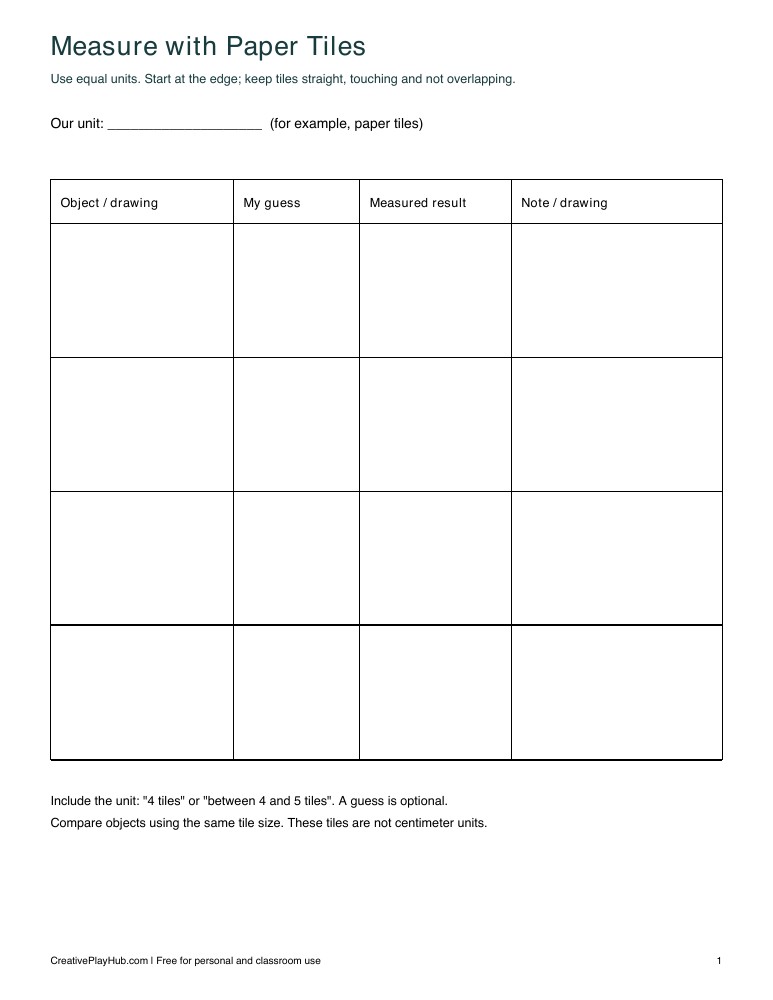
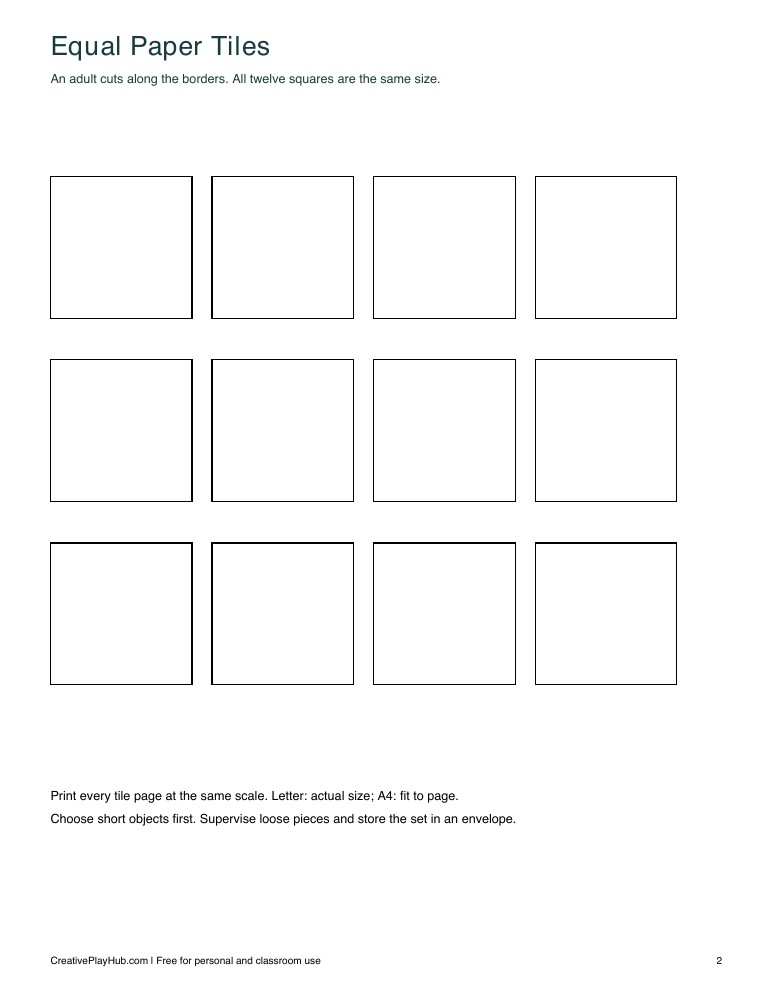
These tiles are nonstandard units, not centimeter squares. Scaling the page is fine if every tile in the comparison comes from copies printed at the same scale. The article’s generated image is illustrative; use the actual PDF preview to see the supplied pages.
Choose objects and prepare the units
An adult cuts along the tile borders. Keep all twelve together and use objects shorter than the total row, such as a small book edge, card or folded paper strip. Avoid irregular outlines for the first attempt. Large identical blocks are an alternative; write ‘blocks’ as the unit instead.
Choose materials appropriate for the child, supervise loose paper pieces, and keep the work within comfortable reach. Measure the object by moving tiles, not by asking a child to stretch across furniture. No cutting is necessary if you use suitable blocks you already have.
Measure one straight edge
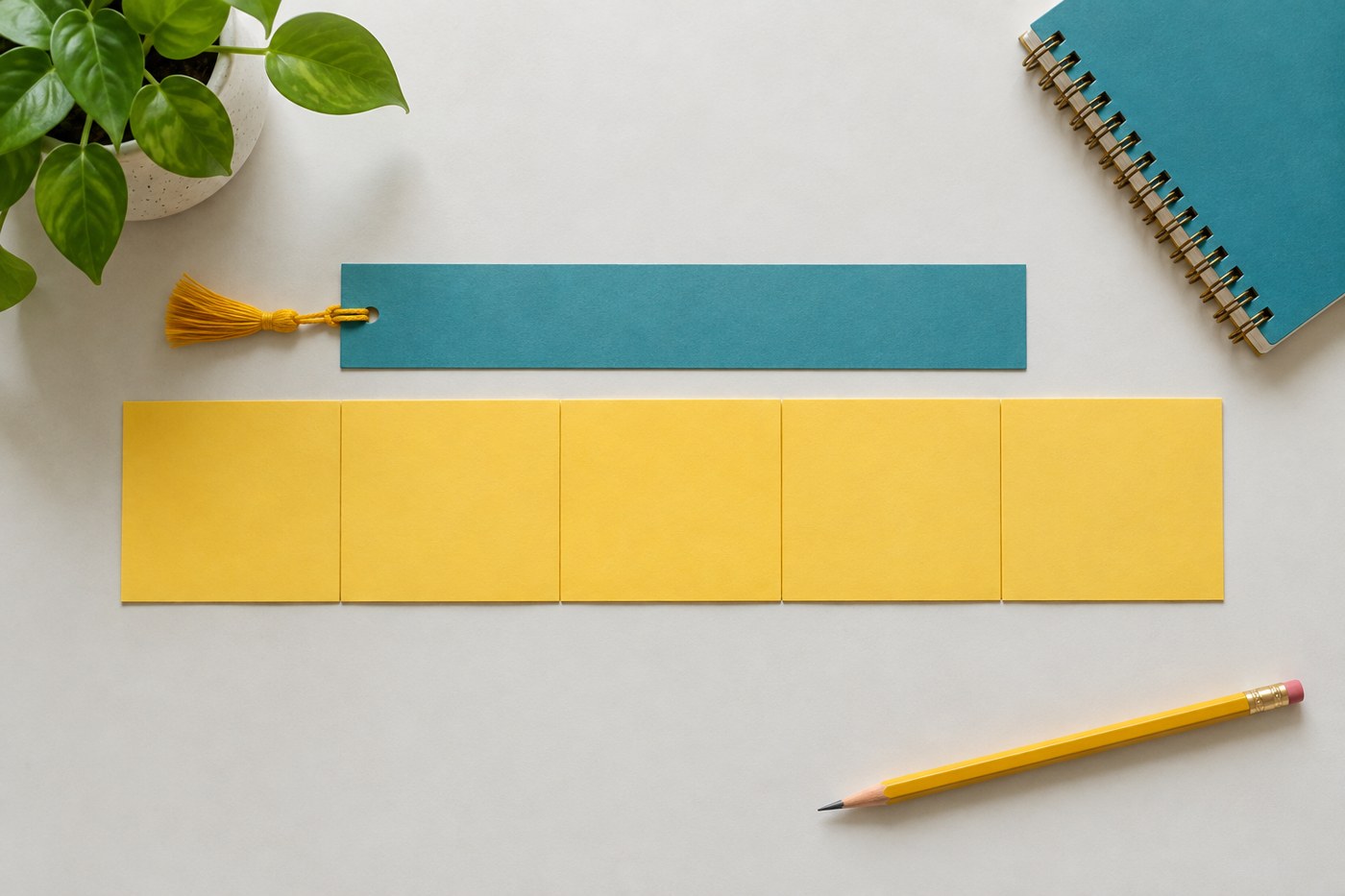
Lay the object flat and choose the edge you will measure. Put the left edge of the first tile level with the start of that edge. Continue the row in a straight line, with tile edges touching and no gaps or overlaps.
Count each tile once. Say the number and unit together: ‘This edge is four tiles long.’ Do not record just ‘four’, because another set of larger tiles could give a different count for the same object.
Handle an object that ends between tiles
If the object ends after the fourth tile but before the fifth tile ends, write ‘between 4 and 5 tiles’ or ‘about 4 and a bit’. The sheet’s result space accepts words; children do not need fractions to record what they see.
An example: a paper strip ends exactly at the end of tile 4, so record ‘4 tiles’. A second strip reaches halfway into the next tile, so record ‘between 4 and 5 tiles’. These are examples, not the measurements of the objects in your home or the generated illustration.
Use the recording sheet without turning it into a test
Draw or name the object in the first column. Make a guess if wanted, arrange the tiles, then record the result. In the last column, note something useful: ‘needed to straighten the row’ or ‘longer than the card’. An adult can write the child’s words.
Compare two results only when the unit size and measuring method are the same. If a book is five of your tiles long and a card is three, the measured book edge is longer. Comparing five small tiles with three larger blocks would not establish that.
Spot three common measurement mistakes
A gap makes the row reach farther with fewer tiles. Overlapping tiles makes it shorter. Starting the row before the object’s edge measures extra space. Invite the child to repair one deliberate example, then check the count again.
If the tiles slide, work on a nonslip surface or use larger blocks. If the object is too long for twelve tiles, choose a shorter object first. Repositioning one tile repeatedly introduces another skill and can wait.
Continue with a related activity
The PDF is for personal and classroom use. Keep the tiles in an envelope and reuse the recording page as a model on scrap paper. You can stop after one well-explained measurement.
Our size sorting cards explore comparison without counting units. The counting cards offer a separate way to practice counting each item once.