Simple activities. Colorful little moments.

Printable Four-in-a-Row Dice Game: Color, Choose and Play
Download a free four-in-a-row dice game with a numbered 5-by-5 board. Includes turn rules, a worked example and an easier no-dice variation.

This printable four-in-a-row dice game combines a little chance with a small choice on every turn. Roll a number, find a matching empty square and color it. Two players try to make a line of four on the same board. The free one-page PDF includes a numbered grid and the rules, so it is easy to keep with a pair of crayons.

Download and prepare the board
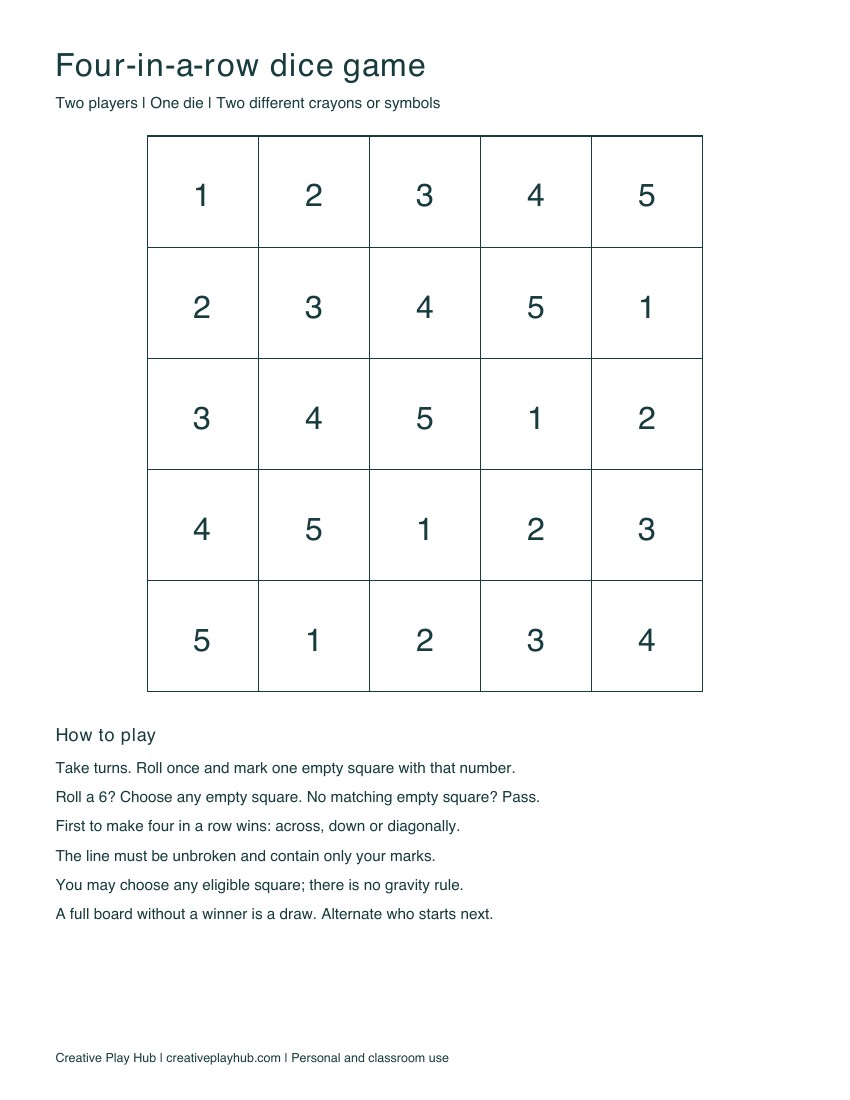
The PDF has one 5-by-5 board numbered from one to five. You need one ordinary six-sided die and two visibly different crayons or pencils. Print in portrait orientation using your printer’s fit-to-page option on A4 or US Letter paper. The illustration is a play scene; use the PDF below for the actual numbered board.
Choose colors that are easy to tell apart, or add different symbols such as a circle and a cross instead of coloring. Keep the numbers readable by making a light mark in each square. You do not need counters, a game-piece cutting session or a special printer.
Follow these turn rules
Choose a starting player, then alternate turns. Roll the die once. A roll of one, two, three, four or five lets you mark one empty square with that number. A six is a free choice: mark any empty square. If every square with your rolled number is already marked, your turn passes without a mark.
The first player with four of their own marked squares in one unbroken horizontal, vertical or diagonal line wins. Other players’ marks interrupt a line. Stop as soon as a line is completed. If the board fills without a winner, the game is a draw. There is no gravity rule: any eligible empty square can be chosen.
Walk through a sample turn
Suppose you roll three. Find the empty squares printed with a three and choose one. You might choose a square beside two of your marks, or one that interrupts a possible line for the other player. You may not color an occupied three or choose a different number unless you rolled six.
A line along row two, columns one through four counts as four in a row. A diagonal through row one column one, row two column two, row three column three and row four column four also counts. Four separate squares scattered around the board do not count, even if they share a number.
Make the first game easier
Before competing, play a few practice turns together. Say the rolled number, locate an empty match and mark it. An adult can point to eligible choices while the child decides which to use. When number matching takes all the attention, postpone the tactical questions.
For a simpler variation, put the die aside and let players choose any empty square on their turn. Keep the four-in-a-row winning rule. For a shorter version, agree before starting that three in a row wins. Avoid changing the target halfway through a game.
Handle draws and repeated passes
If a player cannot use their roll, passing is part of the standard game. For a faster variation, agree in advance that an unusable number becomes a free choice. Use that rule for both players throughout the round. Alternate who starts the next game, and print a fresh board rather than trying to distinguish layers of crossed-out marks.
If your players prefer a smaller board, use our tic-tac-toe printable. For a pencil game without dice, try dots and boxes.