Simple activities. Colorful little moments.

Free Printable Positional Word Cards: 6 Hands-On Activities
Use six free printable positional word cards with a toy and a box. Practice in, on, under, beside, in front of and behind through simple hands-on play.

These printable positional word cards give children a concrete way to explore where things are. Instead of completing a worksheet, they move a toy in, on, under or beside an everyday object. Two more cards introduce in front of and behind, with an adult helping make the viewpoint clear.
The activity is designed for an adult or confident reader to guide. Start with two words rather than teaching all six at once, and stop while the game is still enjoyable. A short session of five to ten minutes is enough for one round, but the cards can return whenever children want another turn.
Download the six cards
The one-page PDF contains six large text cards. Each has a positional word, a short action to read aloud and a reminder to take turns. These are text-based instruction cards, not picture flashcards, so children do not need to read them independently. Print in black and white on US Letter paper, or use fit to page for A4.
An adult can cut along the borders, or you can leave the page whole and point to one instruction at a time. There is no signup required. For repeated use, store the cards in an envelope. Lamination is optional, and plain paper is enough for the activity.
Set up a clear play space
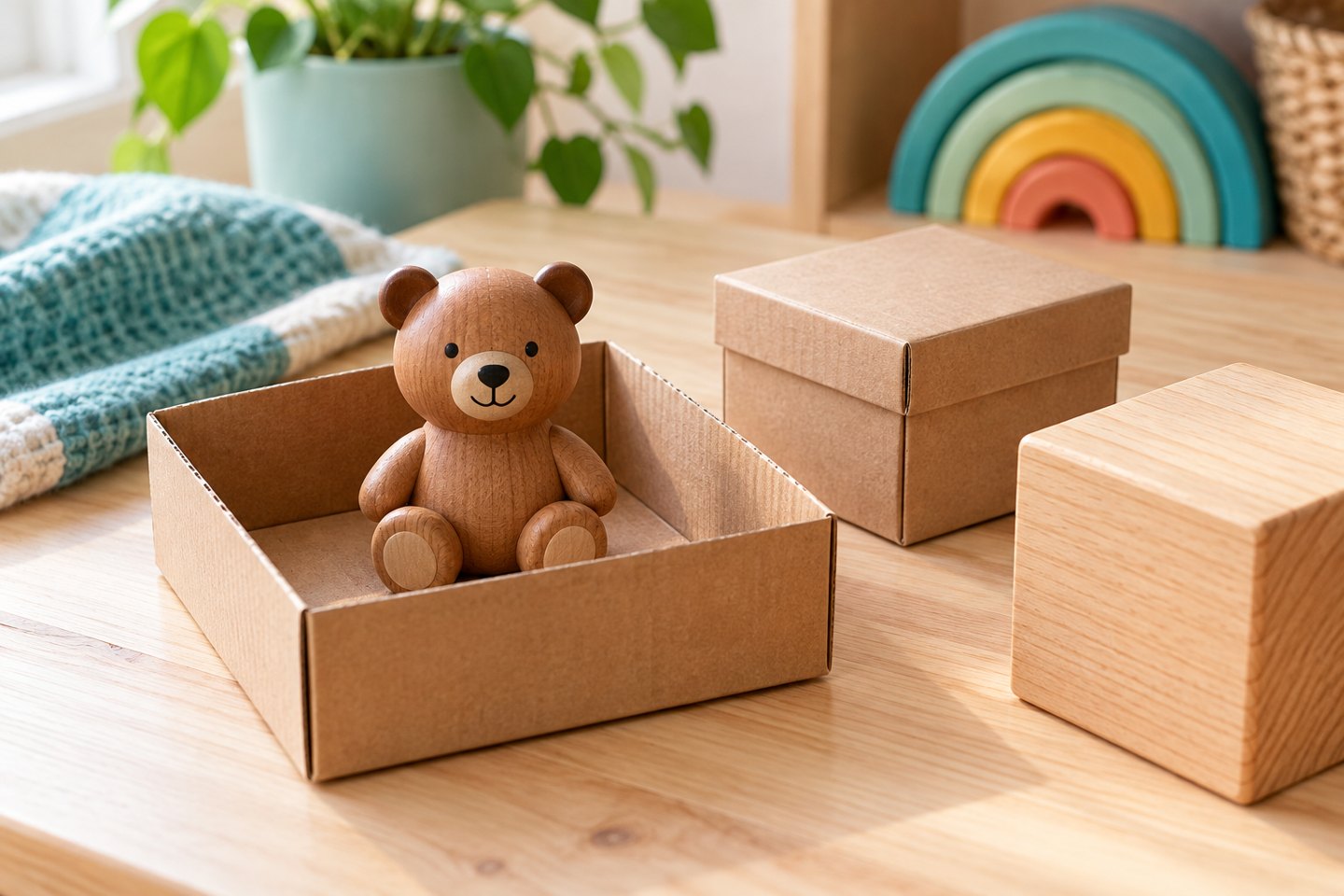
Choose one familiar toy that is suitable for the child, a box that opens and closes, and a table with a clear space underneath. The toy should fit inside the box. Avoid small loose objects around children who mouth things, and keep the game at a comfortable reaching height.
Move the toy rather than asking a child to climb on or crawl beneath furniture. A large toy and a shallow box work well when small pieces are difficult to handle. Sit beside the child so you both face the same way, especially when introducing front and behind.
Begin with in and on
Read the IN card and place the toy inside the open box. Say, “The bear is in the box,” using the toy’s own name if it has one. Lift it out and offer the child a turn. Let them point, direct your hand or move the toy themselves, depending on what is comfortable.
Close the box before trying ON. Put the toy on its top and describe what you did. Alternate between the two locations slowly. An open box can make the difference confusing, so make the setup visibly different before asking a child to choose the correct place.
Add under and beside
For UNDER, put the toy beneath the table where it can still be seen and reached. Compare the toy on the table with the toy under it. Keep other materials out of the way so the location, rather than the hiding challenge, remains the focus.
For BESIDE, place the toy next to the box with a small clear gap. Try the other side too: beside does not mean only one particular side. Use a short sentence each time, then swap roles and let the child tell you where the toy should go.
Make front and behind less confusing
A plain box has no obvious face or front. Mark one side with a large drawn door, and agree that this is the front for your game. Put the toy in front of that marked side. Move it to the opposite side for behind, keeping the box in the same orientation.
If you move around the table, the toy may look different from your new viewpoint. Return to the same side before comparing answers, and explain which object you are using as the reference. Accept a child’s question or different interpretation as a reason to clarify the setup, rather than treating it as a wrong answer.
Three small games to try
Follow the card: Read one instruction, let the child place the toy and describe the result together. Be the teacher: Let the child choose a card and guide the adult. Spot the change: Move the toy while the child watches, then ask what is different about its position.
Use the words naturally in other play without turning every moment into a quiz. A puppet might sit beside a stage or a car might go under a cardboard bridge. Our cardboard building activities offer simple structures for this kind of play.
Printing and learning questions
Should every word be mastered before playing? No; model a word, offer a turn and revisit it later. Can the cards work with a group? Yes, with one toy-and-box setup per pair or a shared demonstration. For another hands-on printable, try our size sorting cards. These activities provide practice opportunities, not a developmental assessment or a promise of a particular learning outcome. The PDF is for personal and classroom use.