Simple activities. Colorful little moments.

Shadow Puppets for Kids: Make a Simple Cardboard Screen
Make shadow puppets for kids with card, a paper screen and an LED flashlight. Includes setup, a two-character story and fixes for blurry shadows.

Shadow puppets for kids need only a light, an opaque shape and a surface to catch the shadow. This tabletop version uses a cardboard frame and a paper screen, so the audience can sit on one side while the puppeteer works behind it. Start with two characters and a story lasting about one minute; a small show is much easier to coordinate than a whole cast.
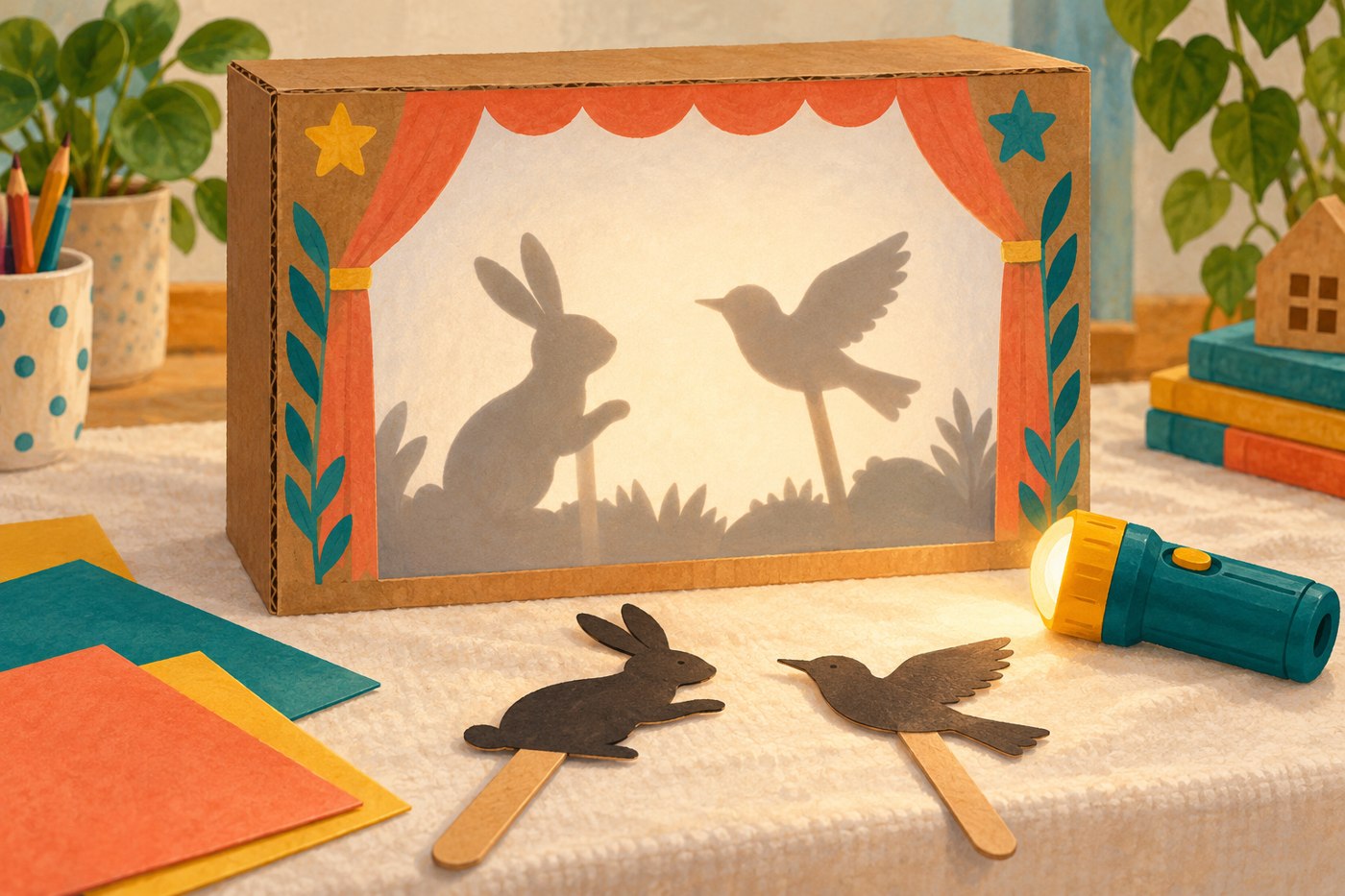
Gather the materials before dimming the room
Use a clean cardboard box, one sheet of tracing paper or thin white paper, dark card, tape, scissors and a battery-powered LED flashlight. Broad folded-card handles work well for the puppets. An adult should cut the box opening, remove staples and cover rough edges. Avoid candles, hot lamps and pointed skewers.
Allow roughly 20 minutes for making the screen and puppets, then leave the performance length up to the children. Keep enough room light to see the floor and move safely. Position the flashlight on a steady surface; do not shine it into anyone’s eyes.
Build a screen that stays upright
Cut a rectangular opening in the broad front of the box, leaving a border about 4 cm wide. Tape the paper across the opening from inside, pulling it gently flat without tearing it. Leave the back open for access. The box sides form the support, so no elaborate stand is needed.
Place the light behind the screen, facing the paper. Hold a piece of card between the light and screen to test it before decorating anything. If thick white paper blocks too much light, try thinner paper. You can also skip the box and cast shadows onto a plain wall.
Make two recognizable silhouettes
Draw a rabbit with a rounded body and two broad ears, then a bird with a beak and one wide wing. Make each shape about the size of an adult palm. Cut around the outside; drawn eyes and feather lines will not appear in a solid silhouette, so concentrate on the outline.
Tape a folded strip of card to the back of each character, extending below it as a handle. Keep the tape away from any narrow neck or ear. Hold the puppets close to the screen for a clear starting image. The generated illustration is inspiration; you do not need its decorative scenery.
Try a one-minute rabbit-and-bird story
The rabbit enters from the left and asks where the moon has gone. The bird enters from the right, looks upward and suggests looking behind a cloud. A third plain circle of card can represent the moon, or the characters can simply describe it. End with both characters saying goodnight.
With two children, give each one a character. With one child, an adult can narrate while the child moves both puppets in turn. Pause between entrances so the audience can recognize who is speaking. Repeat the same short scene before inventing a longer version.
Fix unclear shadows without rebuilding
If the outline looks fuzzy, bring the puppet nearer the screen and check that the flashlight is steady. If the character disappears, move it back into the lit area. If hands dominate the picture, lengthen the card handle or hold it lower. Change one thing at a time so you can see what helped.
For another experiment, keep the light and screen still and move one puppet slowly toward the light, then back toward the screen. Ask what changes about its apparent size. There is no need for a worksheet or a correct prediction before trying it.
Store the show for another evening
Keep the flat characters in an envelope inside the box and switch off the flashlight after play. Next time, add just one new prop, such as a tree. Children can draw a simple sequence of three scenes before performing.
If your child prefers visible puppets, try our paper bag animal puppets. Our cardboard puppet theater offers another stage format.