Simple activities. Colorful little moments.

Finish the Drawing Prompts for Kids: 12 Easy Starting Shapes

Finish-the-drawing prompts for kids begin with one small mark instead of a blank page. A curved line might become a slide, a sleeping cat or the roof of a strange house. There is no single correct picture to copy.
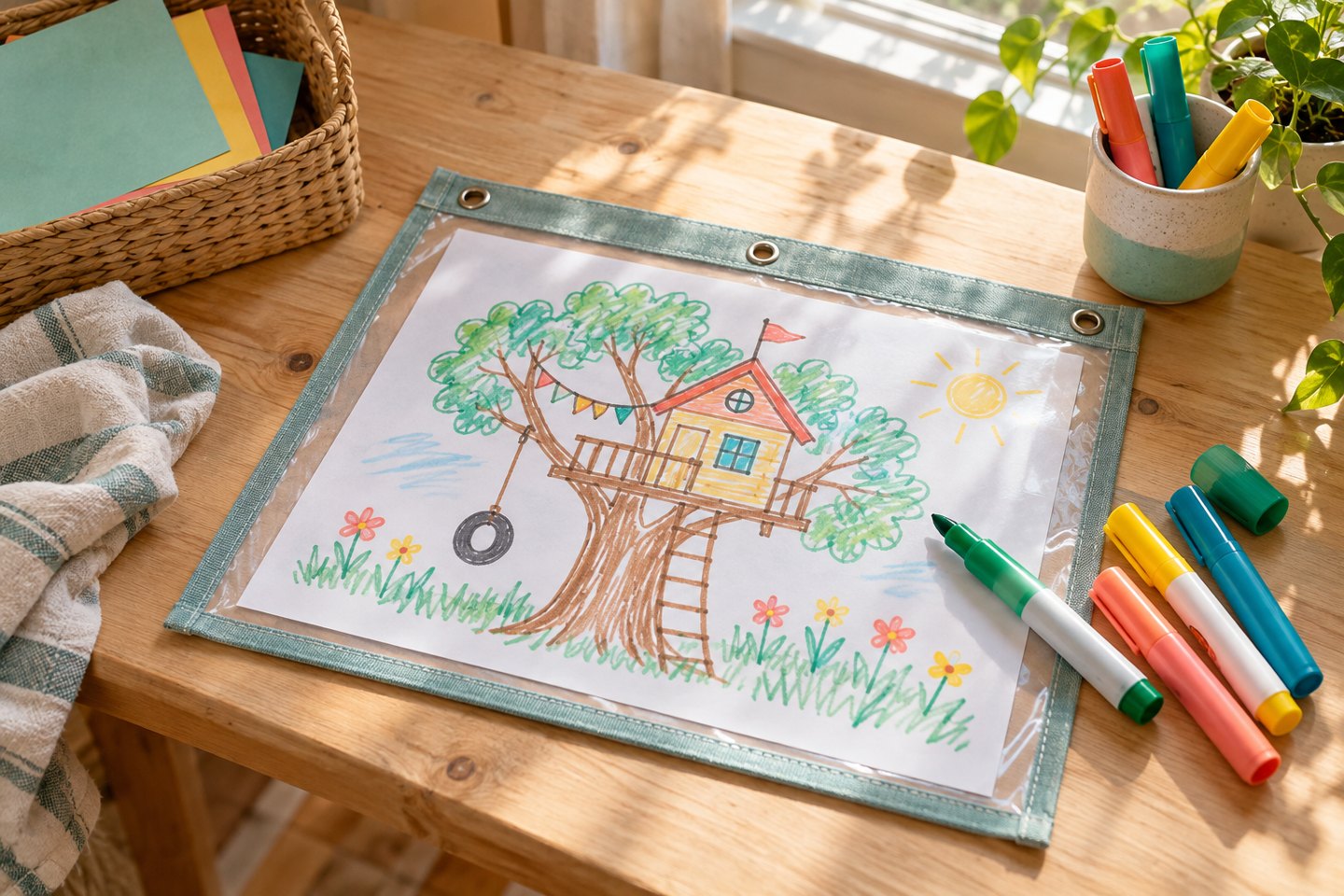
This no-print activity uses ordinary paper and crayons or pencils. Allow ten to twenty minutes, or use one prompt for a short waiting-time activity. It suits children who enjoy making marks; an adult can prepare the starting shapes for anyone who needs help.
Prepare a page in two minutes
Fold a sheet into four sections, then open it. Draw one small starting mark in each space. Keep plenty of empty room around it: a tiny circle in the center leaves more possibilities than a large finished face.
Invite the child to turn the page before deciding what to draw. Say, “What could this become?” rather than naming your own idea first. The suggestions below are backups for a child who asks for help.
1–4: Start with a dot, curve, corner or circle
1. One dot: Turn it into an eye, the center of a flower or a distant planet. Try making the smallest detail the beginning of the biggest picture.
2. A curved line: Add a shell around it, make it a wave or use it as the back of a creature. Rotate the page to find another possibility.
3. An L-shaped corner: It could become a chair, the edge of a building or a robot’s foot. Add something beside it to show its size.
4. An open circle: Leave a small gap and decide what passes through it. Perhaps it is a doorway, a bubble machine or the entrance to a tunnel.
5–8: Try a zigzag, two lines, an oval or a spiral
5. A short zigzag: Build mountains, a crown or the teeth of an imaginary creature around it. The finished picture can be funny rather than realistic.
6. Two parallel lines: Make a path, a ladder or the neck of a very tall animal. Add a destination if the lines become a road.
7. A sideways oval: Draw a pond, a spaceship window or a plate with an unusual lunch. Ask what might be just outside the picture.
8. A loose spiral: Try a snail shell, a spinning cloud or the center of a maze. Keep the spiral visible inside the finished drawing.
9–12: Combine simple marks
9. Three dots in a row: Connect them into something new or make each dot part of a different object. A train with three windows is one option.
10. A square with one missing side: Turn it into a shop, a container or a machine that makes something unexpected. Decide what belongs in the opening.
11. A wavy line above a straight line: Make a landscape, a patterned scarf or a sandwich. There is no need to keep the page the same way up.
12. A triangle beside a tiny circle: Find a way to include both in one scene. They could be unrelated objects, such as a tent and the moon.
Play a two-person swap game
Each person draws a starting mark on their own sheet, then swaps papers. The other person adds three details and returns it. The first person finishes the picture and gives it a title.
Agree before starting that the page belongs to both artists during the game. If a child dislikes having their work changed, use separate sheets with the same starting mark instead. Compare the different ideas without choosing a winner.
Make it easier or add a challenge
For a simpler version, offer just two marks and thick crayons. A child can describe the idea while an adult adds requested details. Avoid correcting proportions or turning the activity into a drawing lesson unless the child asks.
For a bigger challenge, repeat the same starting mark in four boxes and invent four different endings. Another option is to connect three finished pictures into a beginning, middle and end using our comic strip template.
When the child says “I do not know”
Offer a choice of categories: “Could it be something outside or something in a kitchen?” If that does not help, invite a pattern instead of an object. Stripes, dots and extra curves count as finishing the picture.
For a different starting point, our printable drawing prompts use ideas rather than starting marks. Choose whichever approach feels inviting that day.
Common questions
Do we need a worksheet? No. Hand-drawn marks on scrap paper are enough; this guide does not require a download.
Can several children use one prompt? Yes. Give each the same mark on a separate sheet and display the different interpretations together.
Should I demonstrate a finished example? Try waiting until asked. Showing a complete picture first can make copying seem like the goal.