Simple activities. Colorful little moments.

Free Printable Drawing Prompts for Kids: 6 Creative Ideas
Download six free printable drawing prompts for kids. Set up an easy drawing station, reuse the cards and adapt each idea without needing a model picture.

These free printable drawing prompts for kids offer a starting point for the familiar question, ‘What should I draw?’ Each card suggests an imaginative subject and one optional follow-up question. There is no model picture to copy, so two children can use the same prompt and create very different drawings.
The six ideas work well in a small drawing basket, during a quiet afternoon or as an open-ended classroom choice. Use one card at a time and let children decide when a drawing is finished. A few minutes of sketching counts just as much as a detailed scene.
Download the six drawing prompt cards
This one-page PDF includes six cards: invent a tree house, design a friendly robot, draw an unusual vehicle, make a tiny world, invent a new playground and draw a surprising pet. Each card has room for a small sketch. Print on US Letter paper or select ‘Fit to page’ for A4. The black-and-white design is easy to print, and no email signup is needed.
Set up a simple reusable drawing station
Place the prompt sheet beside scrap paper and a few pencils or crayons. Cut the cards apart if you want children to choose from a stack; an adult can handle cutting. Keep the original printed cards clean by doing larger drawings on separate sheets. A small folder is enough to store both the cards and unfinished pictures.
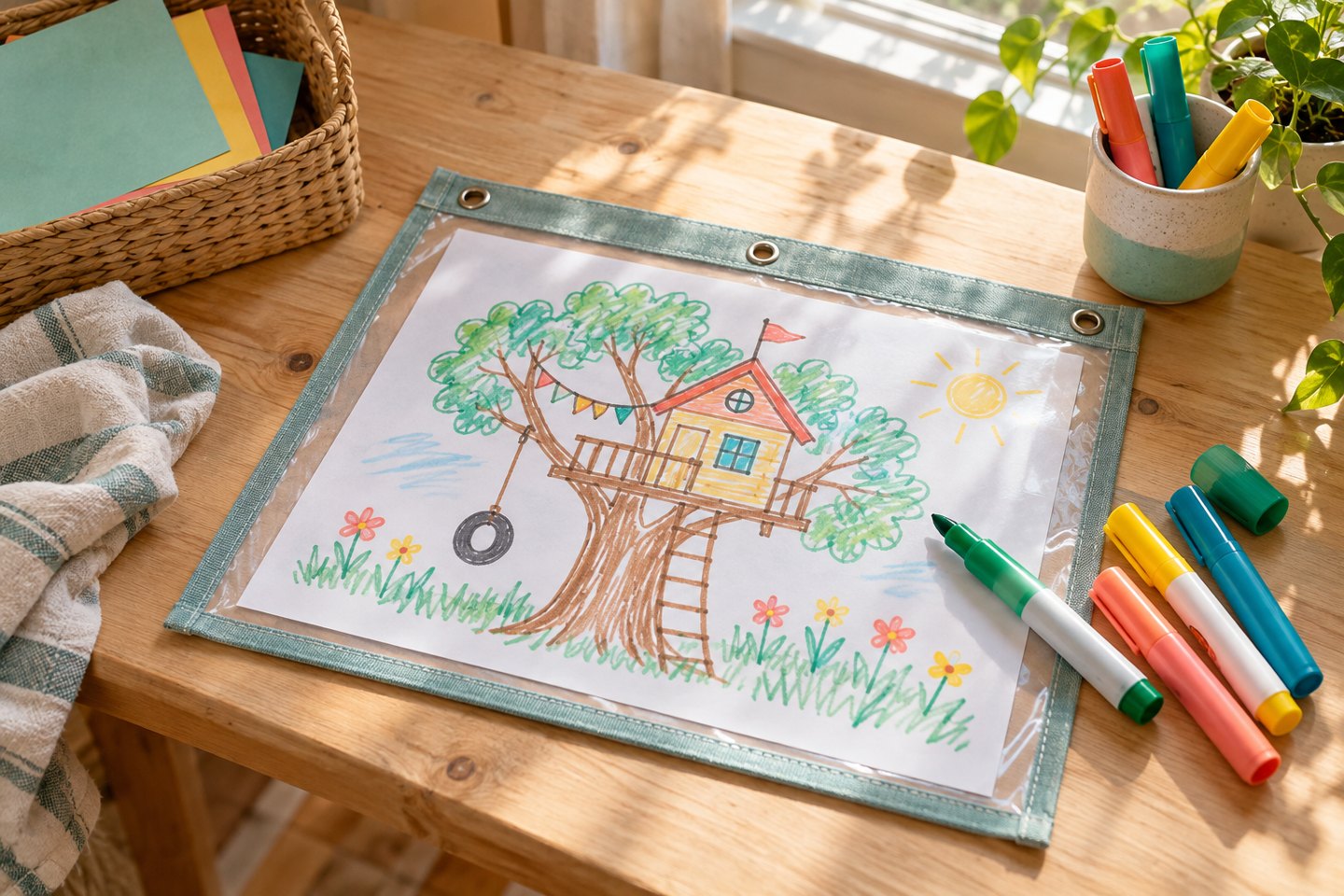
For a wipe-clean option, place a blank drawing sheet in a reusable clear sleeve and use markers intended for that surface. Test one corner first because some sleeves stain. Follow the marker instructions, supervise use and keep caps away from children who mouth small objects. Ordinary paper and crayons remain a good choice if you prefer a simpler setup.
Six prompts and ways to start
Invent a tree house: begin with a tree and one room. The card asks what you would put inside; a slide, a reading nook or a kitchen could become the next detail. Children can draw the inside, the outside or both.
Design a friendly robot: choose one helpful job, then add a part that helps with it. A robot that waters plants might carry a watering can. Draw an unusual vehicle: decide where it travels before adding wheels, wings or another invented way to move.
Make a tiny world: draw a place small enough to fit in a box, then decide who lives there. Invent a new playground: add something that spins, or choose a different movement if that suggestion does not appeal. Draw a surprising pet: imagine where it sleeps and what makes its home comfortable.
Help without taking over the picture
If a child feels stuck, offer a small choice: ‘Would your vehicle travel in the sky or under the ground?’ Wait for their answer before suggesting more. You can make your own drawing alongside them, but avoid correcting the proportions or showing a finished example they feel they must match.
Ask open questions such as ‘Tell me about this part’ instead of guessing what every mark represents. A child may want to dictate a short story for an adult to write on the back. Another may prefer to keep the drawing unexplained. Both approaches leave the picture under the child’s control.
Reuse one prompt in different ways
Try the same card with a single crayon, a larger piece of paper or a partner who adds one detail at a time. Older children might draw two views of their invention or label its parts. Younger children can make marks while describing an idea aloud. The prompts are invitations, so changing the subject midway is fine.
Save favorite pictures in a folder and return to the same prompt another week if the child wants to. For a more structured drawing activity, try our draw and guess game. To leave room for creative time during the week, use the free weekly activity planner. These prompt cards are free for personal and classroom use; share this article when passing the activity along.
[…] a different starting point, use our drawing prompt cards. Characters from the roll-a-creature game can become the stars of a later […]
[…] does not need to become a reading target or reward system. For more open-ended artwork, try our printable drawing prompts, or explore paper weaving for another paper […]
[…] need to prevent matching ideas. If both draw a sun, ask what is happening underneath each sun. Our printable drawing prompts offer more starting ideas for separate-page […]
[…] a different starting point, our printable drawing prompts use ideas rather than starting marks. Choose whichever approach feels inviting that […]