Simple activities. Colorful little moments.

Drawing Prompts for Siblings: 8 Cooperative Paper Games

Drawing prompts for siblings can give two children a shared project without asking them to produce matching pictures. The useful starting point is a clear agreement: are we sharing one page, or making separate pictures that fit together?
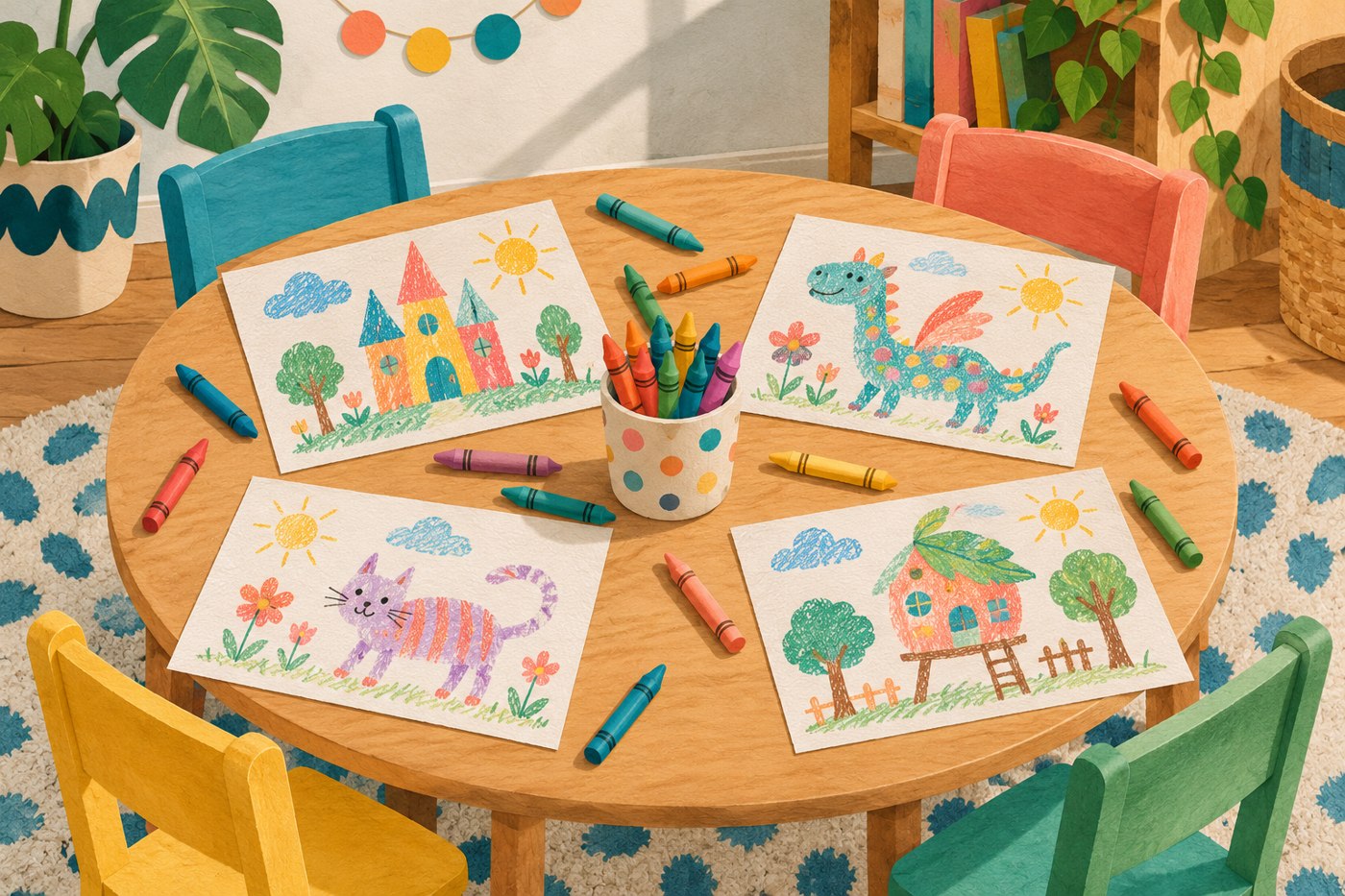
Use paper and crayons or pencils. Choose one of the eight prompts below for a ten- to twenty-minute session. The activities can also work for a child and an adult. There is no score and no need to decide whose drawing is best.
Agree on three rules before starting
Ask before drawing on someone else’s section. Keep each person’s marks instead of erasing or correcting them. Either artist may switch to a separate sheet.
If ages or interests differ, let one child draw large shapes while the other adds optional details in an agreed area. Avoid assigning the older child the job of fixing the younger child’s picture.
1. Two houses, one connecting path
Each child draws a house on their own half of a sheet. The houses can belong to people, animals or imaginary creatures. Together, add a path between them.
Decide what travelers meet along the path: a bridge, a puddle or a snack stand. Ask each child to contribute one feature, then connect the features with the path. Separate sheets placed side by side work too.
2. A creature with agreed sections
Fold a page into three horizontal sections. One child draws a head in the top section, the other draws the body in the middle, and they decide together who adds the feet. Keep the whole drawing visible in this version.
Before starting each new section, ask the previous artist where the joining lines should go. Give the creature a name made from one word chosen by each person.
3. The same shape, two ideas
Draw an identical circle or zigzag on two separate sheets. Each child turns the mark into something different, then explains the picture if they want to.
There is no need to prevent matching ideas. If both draw a sun, ask what is happening underneath each sun. Our printable drawing prompts offer more starting ideas for separate-page drawing.
4. Invent a playground together
Choose two pieces of imaginary playground equipment, one from each child. They might invent a cloud swing or a slide for toy dinosaurs. Draw each invention in a different part of the page.
Connect the areas with a path and agree where the entrance belongs. Treat this as a fantasy drawing rather than a plan to build real climbing equipment.
5. A three-picture story
Make three boxes labeled beginning, middle and end. The first child draws a character arriving somewhere. The second adds a small problem in the middle box. Together they choose an ending.
A missing hat or a picnic interrupted by rain is enough of a problem. Children can dictate captions to an adult. Use our free comic strip template if you prefer prepared panels.
6. Pack an imaginary picnic
Draw a large blanket or table in the middle of the page. Take turns adding one item each. Foods can be ordinary or invented, such as star-shaped sandwiches for a visiting astronaut.
After six turns, decide who is coming to the picnic and add places for them. This gives the drawing a natural stopping point instead of continuing until someone becomes tired.
7. Send a picture clue
On separate sheets, each child draws an object the other knows: a shoe, a cup or a familiar toy. Swap and guess. The artist may add one extra detail if the first guess misses.
Keep it cooperative by letting the guesser ask a question. Avoid a timer if quick guessing leads to frustration. For a ready-made version, try our draw-and-guess game.
8. A map of a tiny imaginary island
Outline an island together, then each child chooses one place to add. Examples include a shell library, a treehouse or a pond for miniature boats. Draw a route that visits both places.
Each artist can make a small symbol for their landmark. Put the symbols in a map key beside the drawing and invite an adult to follow the route.
What to do when sharing stops being fun
If one child starts directing every mark, pause and return to separate pages. Offer a shared theme with individual pictures rather than insisting on one collaborative sheet.
If someone draws over an unwanted area, acknowledge it and offer fresh paper. A cooperative activity should not require a child to accept repeated changes to a picture they wanted to keep.
For children who finish at different speeds, let the first artist make a title card or leave the activity. Nobody needs to keep drawing to match another person’s pace.
Keep the ending simple
Invite each child to mention one choice they made: “I added the bridge because the river needed a crossing.” Display both contributions together if they agree, or let each keep their own page.
Repeat a favorite prompt with a different setting next time. An underwater neighborhood and a mountain neighborhood can use the same two-house structure without requiring new supplies.
Common questions
Can a younger child join? Yes, with a role that suits their interests, such as choosing colors or adding marks. An adult can help with turn-taking.
Do both children need to read? No. Read the prompt aloud and keep the instructions to one step at a time.
What if they want a competition? They can choose one separately, but these prompts are designed around making something together.