Simple activities. Colorful little moments.

Free Printable Number Line 0–10: Count Jumps and Compare
Download a number line from 0 to 10 with jump prompts. Practice starting points, one-step moves, addition and subtraction with clear examples.

A printable number line from 0 to 10 gives children a place to start, a direction to move and a way to check where they finish. This page uses small jumps that stay within the printed range. The free PDF includes a large number line, three practice prompts and space to invent another journey.
Print and introduce the line
Print the one-page PDF in landscape orientation, using fit to page on A4 or US Letter paper. Place it on a table with a pencil or a large paper arrow as a pointer. The article illustration is decorative; the downloadable sheet contains the exact numbers and task prompts.
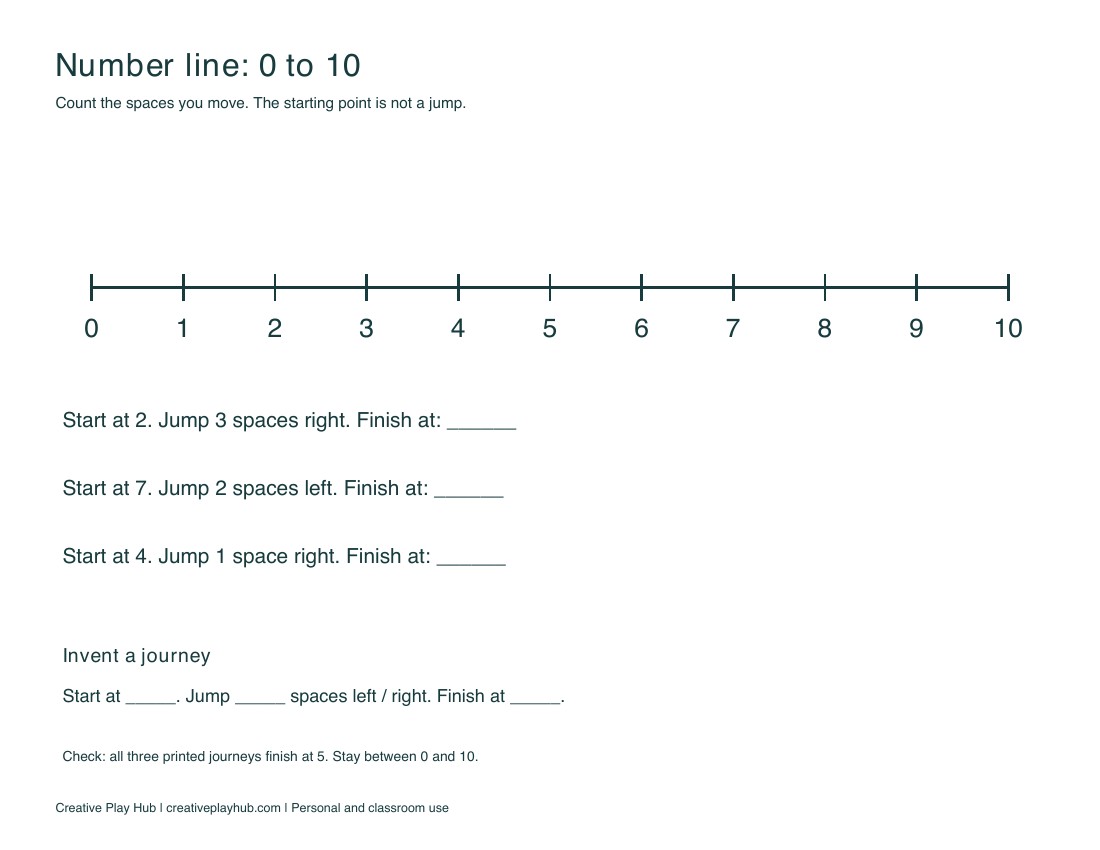
Point out that the labels begin at zero and finish at ten. There are eleven labeled positions and ten spaces between them. Ask the child to find a familiar number before introducing any calculations. Read the numbers from left to right together, then try locating a number without starting the count again.
Count jumps, not the starting number
Place the pointer on two. Move it to the next tick on the right and say one jump. Continue to four and say two jumps. The journey from two to four has two jumps even though you touched three labeled positions: two, three and four.
This is the most useful distinction to practice slowly. Mark a small starting dot and draw one curved arrow between each neighboring pair of ticks. If a child counts the starting position as jump one, return to the dot and say, “We are here, but we have not moved yet.” Then make the first move together.
Try the three printed journeys
The first prompt starts at two and asks for three jumps right. The landing points are three, four and five, so the answer is five. The second starts at seven and asks for two jumps left: six, then five. The third starts at four and asks for one jump right, finishing on five.
All three journeys end at five on purpose. Compare their starting places and directions: different journeys can have the same destination. Ask the child to show the jumps rather than guessing from a previous answer. This also makes it easy to check the activity without a separate answer sheet.
Connect the movement to number sentences
Once the jumps make sense, write 2 + 3 = 5 next to the first journey. Explain that the two is the starting position and the three counts moves to the right. For the second, write 7 – 2 = 5 and match the subtraction to two moves left.
Keep examples within zero to ten. If a proposed journey would run beyond the printed line, choose a different starting point or a smaller number of jumps. Do not silently wrap the pointer from ten back to zero; this line is not a circular game track.
Adjust the activity and check understanding
For an easier start, use only zero through five and one-step moves. For another challenge, cover a destination label after making the jumps and ask what number belongs there. You can also ask which of two numbers lies farther right, then count the spaces between them.
Let the child invent one journey for you in the blank prompt area. Follow it literally and invite them to check your stopping place. If drawn arrows become crowded, use the paper pointer on a fresh print instead. Try our ten-frame activities to compare this number path with a quantity model, or use counting cards for matching numerals to groups.