Simple activities. Colorful little moments.

Masking Tape Roads for Kids: Build a Little Indoor Town
Make masking tape roads for kids with simple lanes, cardboard buildings and five play ideas. Includes setup, surface checks and easy cleanup tips.

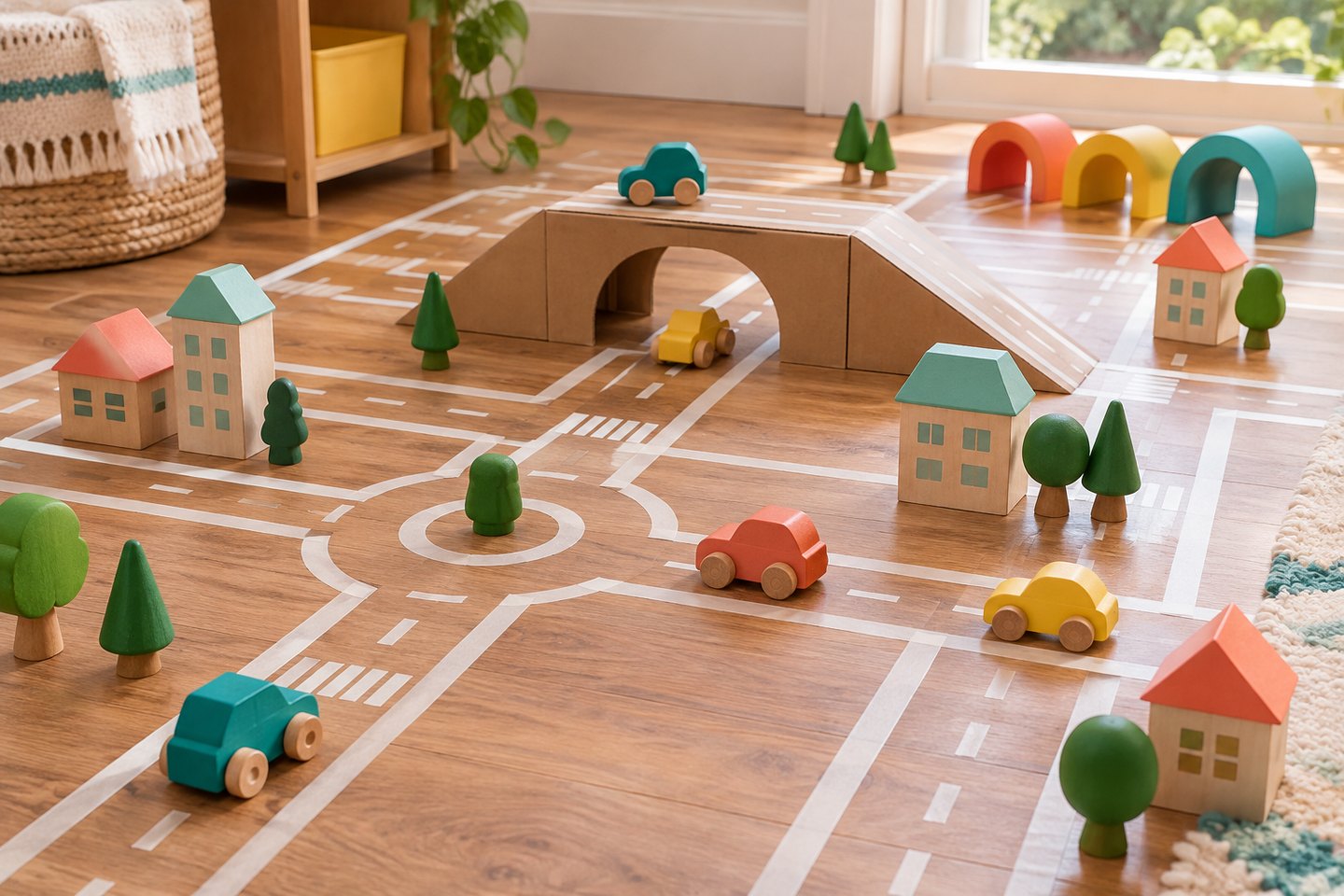
Masking tape roads for kids turn a small stretch of floor into a town that can change with every game. Start with one road and two destinations, then let children decide whether their town needs a park, a bridge or a very unusual shop. You do not need a printed road mat or a matching set of toys.
This setup works as a quiet car game, a building invitation or a shared storytelling activity. Allow about 10 minutes to make the first road, with extra time for adding buildings. Choose a clear play area away from doors and walkways, and keep the layout small enough to tidy up easily.
Gather a few simple materials
Use low-tack masking or painter’s tape suitable for your surface, a few toy vehicles, wooden blocks and clean empty cardboard boxes. Paper and crayons are useful for drawing parks or signs. Choose vehicles and loose materials appropriate for the children playing; avoid small pieces around children who still put objects in their mouths.
Tape can lift paint or finishes even when it is sold as removable. Follow the tape maker’s surface guidance and test a short piece in an inconspicuous spot first. If you are unsure about the floor, build the roads on a large, flat piece of cardboard instead. That also makes the whole town easier to move.
Build the first road together
Lay two parallel strips of tape with enough space between them for the widest vehicle. Keep the tape flat, without raised loops. Make a short straight road first, then add a bend using several short pieces. A simple T-shaped junction is usually easier to build and understand than a complicated network.
Place a block house at one end and a cardboard garage at the other. Ask where the car is going and let that answer shape the next addition. If a child wants a giant winding road, build one section at a time. Leaving open floor space gives hands and vehicles room to move.
Try five ways to play
Delivery route: Put a large paper parcel beside the garage and choose a destination. The driver collects it, follows the road and tells the person at the destination what has arrived. A drawn parcel works just as well as a physical one.
Town builders: Add one building after each journey. A library could be a folded sheet of paper; a garden could be a green rectangle with flowers drawn on it. Invite children to explain what happens there instead of trying to make every building look realistic.
Road repair: Close one road with a flat paper sign and find another route. Keep the challenge playful, with no need to race. If there is only one route, children can build a short detour or decide the car will wait while the pretend repair is finished.
Bridge designers: Fold stiff cardboard into a low bridge and test whether a car fits beneath it. An adult can trim rough edges. Keep structures low and use them for toys only. For more building challenges, try our cardboard building activities.
Story journeys: Choose a beginning, a problem and an ending. Perhaps a bus is taking animals to a picnic, but the park has moved. Children can narrate, make vehicle sounds or point to the next destination. There is no single correct story to complete.
Adapt the town for different players
For a younger child, offer one wide road and a single car. For children who enjoy drawing, provide paper signs and a map-making corner. For a shared game, give each player a destination to design and agree on space for both. A tabletop cardboard version can make the activity easier to reach.
Add a pretend shop using ideas from our pretend play shop guide, or save the road for a short second play session if the tape instructions allow it. The useful part is a layout children can change, rather than a town that an adult has already finished.
Cleanup and common questions
Do you need toy cars? No. Large wooden blocks can become buses, or children can move a finger along a cardboard road. How do you remove the tape? Follow the product directions, peel slowly and stop if the surface starts to lift. Remove tape promptly rather than leaving it down indefinitely, and collect the pieces before putting the building materials away.
[…] For two children, one can be the dispatcher and point to the destination while the other drives. Swap after each delivery. For more open-ended town play, use our masking tape roads guide. […]